What is AI penetration testing?
AI penetration testing has two meanings. One is using AI to test your own websites, servers and apps for weaknesses. The other is testing AI systems, such as chatbots, for ways to trick them. EluxAI delivers the first: AI-assisted testing of your systems, done without damage and only with your written authorization. Every finding is confirmed before you see it.
To be clear, we do not sell testing of AI chatbots. This service protects the websites, servers and apps you run, and nothing is tested until you sign a written authorization.
Most vulnerability scanning stops at a list of things that might be wrong. A human-led penetration test goes much deeper, usually once a year. Our agents sit between the two and add something neither one offers.
What is revolutionary is what happens after the scan. Each finding is confirmed, a fix is written for you, and the fix is watched until it proves safe. It is one of eleven agent services in our AI for business lineup, and it is built for owners who want answers, not a spreadsheet of maybes.
Why does every engagement start with written authorization?
Because testing a computer system without permission is a crime in Canada. The Criminal Code makes unauthorized use of a computer, done fraudulently and without colour of right, an indictable offence with up to 10 years in prison. The owner's signed authorization is what makes a test lawful, so we never test a single system without one.
You can read section 342.1 of the Criminal Code on the federal justice laws website. Our scope letter turns that legal line into a practical checklist:
- Every web address and system in scope, and everything excluded
- The testing window, and who to call if something looks wrong
- Confirmation that the signer owns or controls each system
- Hosted platforms and software services you do not control stay out of scope
Agencies, take note. You cannot authorize testing of a client's website on the client's behalf, so each client signs for their own systems and each client's results stay in a private workspace.
What does our website security scan look for?
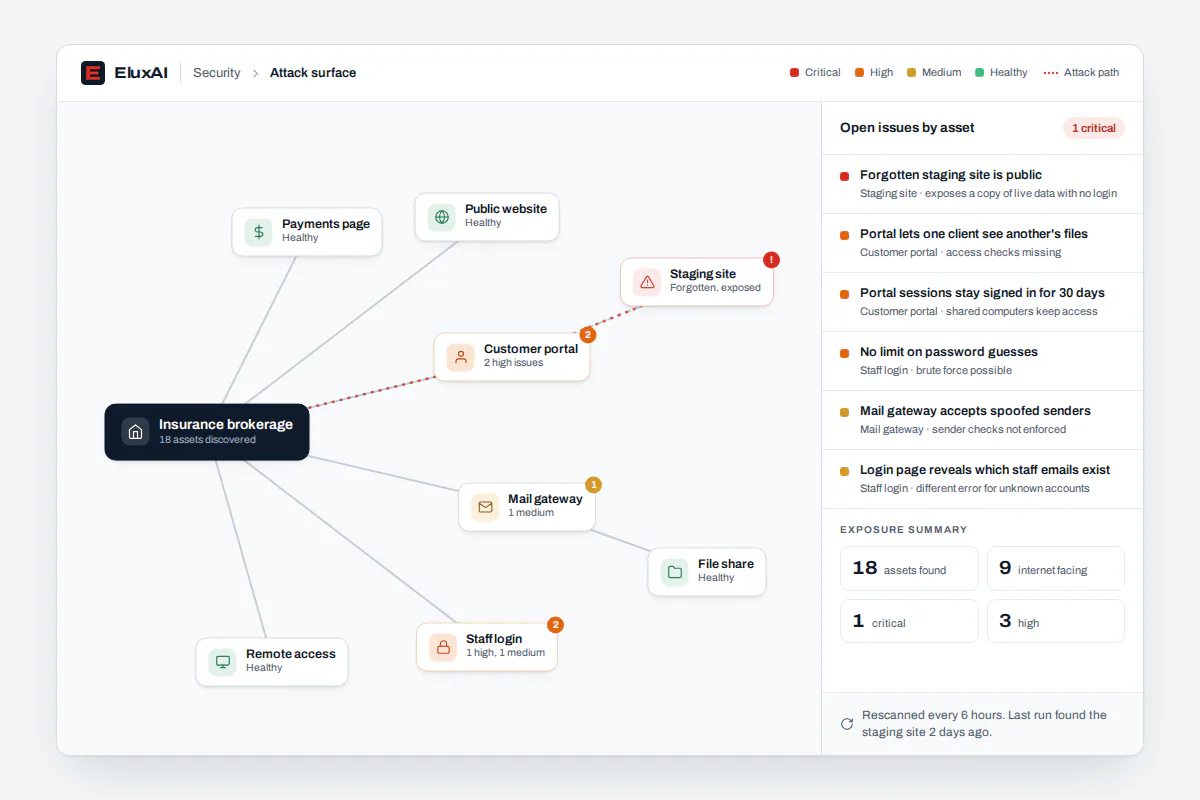
Our agents look at your business the way an outsider would. They find every public web address, subdomain and open door connected to you, check whether a firewall protects your site, and compare your website software and add-ons against published vulnerabilities. They also look for files left public and weak security settings, all without damaging data or disrupting service.
Everything you expose
- Forgotten subdomains, old test sites and addresses nobody remembers launching
- Open doors on your servers that should be closed
- Whether a firewall sits in front of your website
Your website and apps
- Outdated software and add-ons with published vulnerabilities
- Ways an outsider could discover user account names
- Files, settings and data that should never be public
Settings that protect visitors and your brand
- Encryption, browser security settings and cookies
- Email settings that stop someone sending fake email from your domain
Nothing on this list involves taking a service down, guessing passwords at scale or changing your data. Those limits are written into every engagement.
How does the red-to-purple loop confirm findings and fix them?
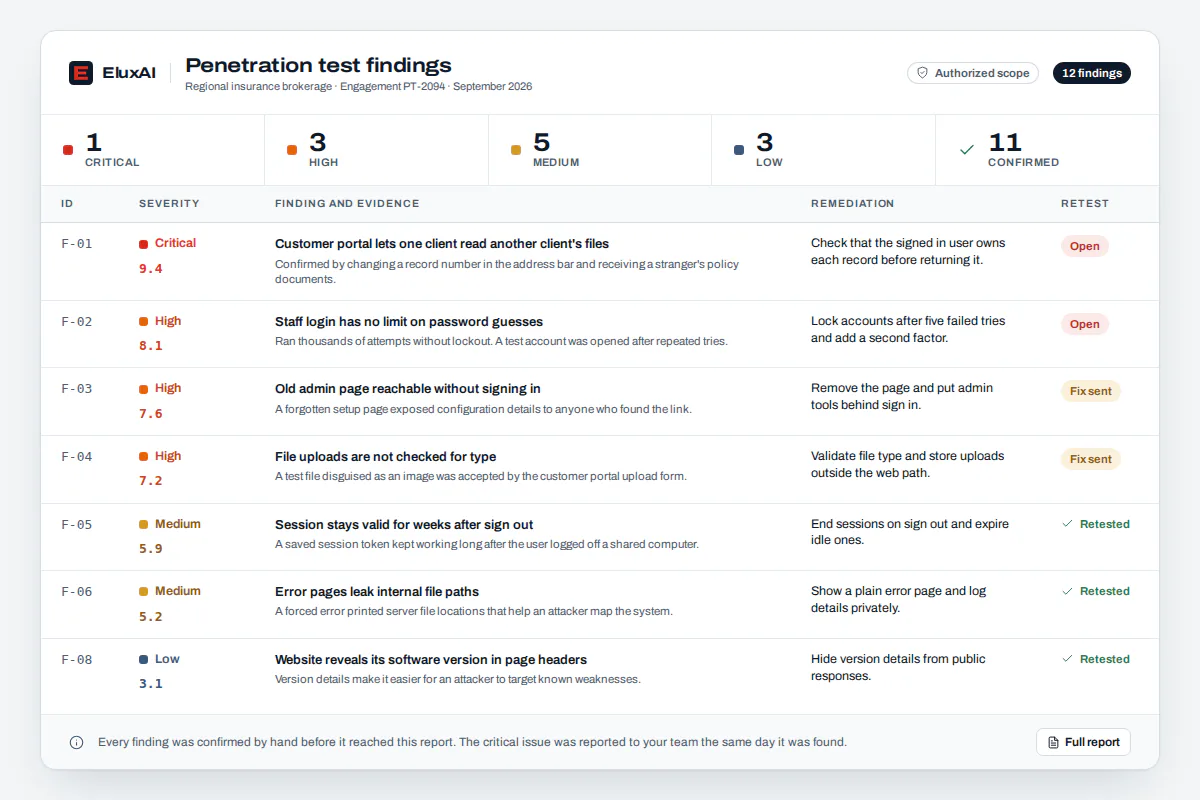
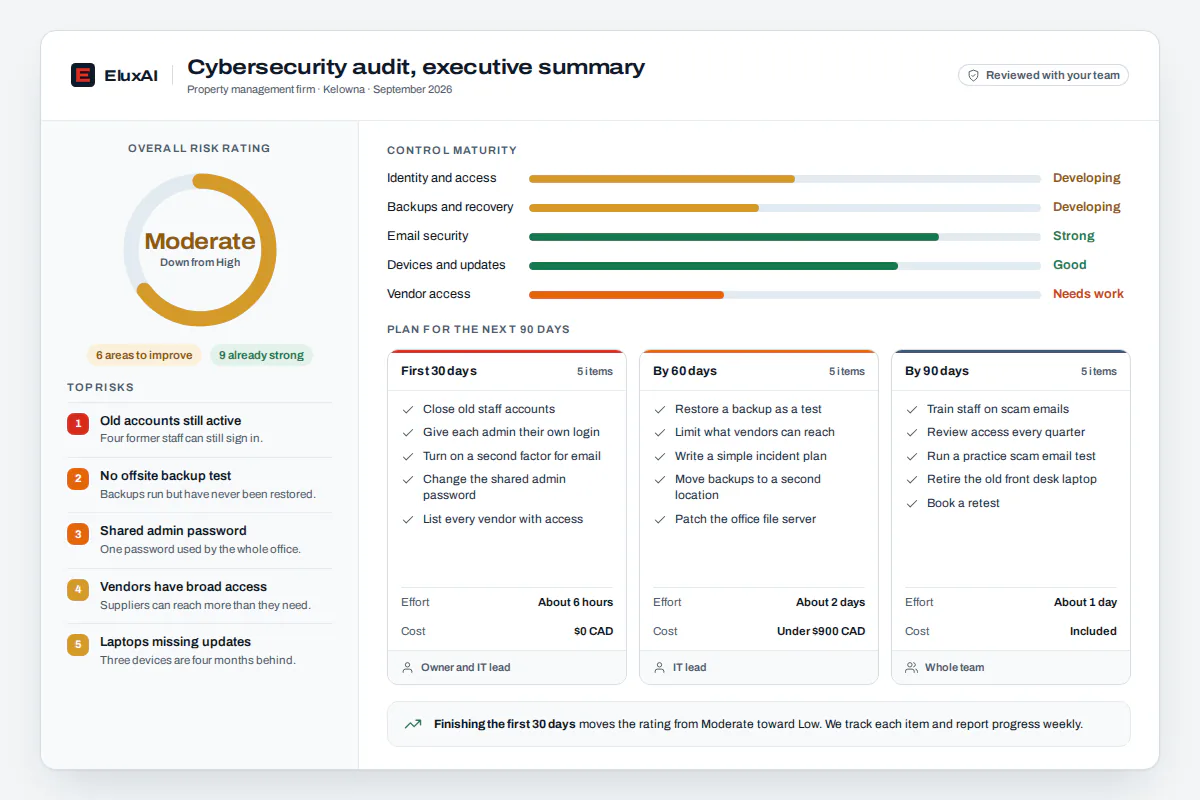
In security, red means attack and purple means attackers and defenders working together. Our red side confirms each weakness is real, which removes false positives. Our purple side then writes a fix you can deploy, such as a security setting change or a software update. You get an executive summary for leadership and technical detail for whoever maintains your systems.
We call the full cycle the Authorized Red-to-Purple Loop:
- Scope. Signed written authorization naming every system, the window and the exclusions. No scope, no testing.
- Map. Find everything you expose online, including forgotten subdomains and open doors.
- Probe. Check software, add-ons, public files and security settings, non-destructively.
- Prove. Confirm each finding is real; unconfirmed items are dropped or clearly labelled.
- Patch. Deliver a fix you can deploy, with an executive summary and technical notes.
- Watch. Monitor every patch for three days and roll it back if errors return.
What happens between assessments?
Security does not stop on report day. After an engagement, our agents run a daily security self-test and open a ticket for each new finding. Every patch is watched for three days and rolled back if errors return. Suspicious files your team receives can be checked safely without anyone opening them, which keeps a fake invoice from becoming an incident.
A yearly report tells you where you stood last spring. Daily self-tests with automatic patch rollback are a revolutionary change for a small business that cannot afford a security team.
This approach lines up with the Canadian Centre for Cyber Security's baseline controls for small and medium organizations, which include automatically patching software and securing websites. Findings flow into the same ticket desk our AI agents use, so every issue has an owner.
Vulnerability scanning vs AI assessment vs a human-led penetration test
A vulnerability scan matches software versions to known issues and produces a long list with many false alarms. A human-led penetration test proves the worst case, usually once a year. Our AI-driven assessment sits between them: it confirms what is real, hands you fixes and keeps checking daily. Audits that require a human-led test still need one.
| Question | Automated vulnerability scan | EluxAI AI-driven assessment | Human-led penetration test |
|---|---|---|---|
| What it does | Matches versions to known issues | Maps what you expose, tests safely, confirms findings | Experts chain attacks and test business logic |
| Destructive techniques | No | No | Sometimes, by agreement |
| False positives | Common | Reduced by the confirmation step | Low |
| Fixes | Generic advice | Fixes ready to deploy, plus executive summary | Written recommendations |
| Frequency | Continuous or weekly | Daily self-test plus periodic full assessments | Usually yearly |
| After a patch | Nothing | Watched for three days, rolled back if needed | Nothing until the next test |
| Evidence for compliance audits | No | Supporting evidence only | Yes |
Verdict: scans tell you what might be wrong, a human pen test proves the worst case once a year, and our agents confirm what is wrong, help fix it and keep checking.
Why do Canadian businesses need continuous security testing?
Because attackers scan continuously and the cost of a breach keeps climbing. Statistics Canada found about 1 in 6 Canadian businesses were impacted by cyber security incidents in 2023. IBM's 2026 report puts the average Canadian data breach at a record CA$7.11 million, and 48,185 new software vulnerabilities were published in 2025 alone.
The Canadian Centre for Cyber Security's National Cyber Threat Assessment warns that threat actors are constantly scanning for publicly known vulnerabilities and exploiting unpatched systems. It also says AI is lowering the barrier to entry for attackers.
Recovery spending by Canadian businesses doubled from about $600 million in 2021 to $1.2 billion in 2023, according to Statistics Canada. Organizations that used security AI extensively paid CA$5.5 million per breach on average, versus CA$8.91 million without it, in IBM's Canadian results.
What do PIPEDA and Quebec Law 25 mean if testing uncovers a problem?
A vulnerability on its own is not a breach. If testing shows personal information was actually accessed without authorization, PIPEDA requires a report to the Privacy Commissioner when there is a real risk of significant harm, and breach records must be kept for two years. Quebec's Law 25 adds its own reporting duties and much larger penalties.
Knowingly breaking PIPEDA's breach rules can bring fines of up to $100,000, as the Privacy Commissioner's guidance and the Act explain. Under Law 25, penal fines can reach $25 million or 4% of worldwide turnover, whichever is greater.
If our agents see signs of past unauthorized access, we flag it to you immediately. Your privacy lead or lawyer decides whether it must be reported.
How much does penetration testing cost in Canada?
Typical Canadian market ranges put most penetration tests between about $5,000 and $30,000, with mid-market engagements mostly between $8,000 and $20,000. Automated vulnerability scanning for a small business costs roughly $2,000 to $8,000 a year. These are market ranges, not our prices. EluxAI quotes after a free scoping assessment of your systems.
| Engagement | Typical market range | Source |
|---|---|---|
| Most Canadian penetration tests | $5,000 to $30,000 | Canadian cost guide, July 2026 |
| External network test | $5,000 to $12,000 | Same guide |
| Web application test, standard scope | $12,000 to $25,000 | Canadian cost guide, June 2026 |
| Cloud environment test, standard scope | $25,000 to $40,000 | Same guide |
| Small business network test | $8,000 to $25,000 | Canadian SMB guide, 2026 |
| Vulnerability scanning, small business | $2,000 to $8,000 per year | Same guide |
What moves a quote: the number of web addresses and applications, whether logged-in areas are tested, how many environments you run, retesting and reporting depth. Be careful with very cheap offers, since quotes under $5,000 are usually automated scans sold as penetration tests. EluxAI quotes after a free assessment, and you can book a scoping call without sharing any access.
Who needs AI penetration testing?
Businesses that hold customer data but have no security team, and the agencies and developers who build for them. SEO and web agencies add security to maintenance retainers. App studios test before launch. Clinics, property managers, online stores and franchises use daily checks to keep booking pages, tenant portals and checkouts from becoming the weak link.
- SEO and web agencies. Outdated add-ons and public files often surface in technical audits too. Each client signs a scope, and daily self-test tickets land in that client's private workspace.
- App developers and software studios. Pre-launch assessments of live and test environments, with an executive summary for investors or enterprise buyers.
- Clinics and professional practices. Booking pages and patient data, tested in clearly scoped, quiet windows.
- Property management and e-commerce. Tenant portals, payment pages and store domains, plus safe checks on suspicious invoice attachments.
- Franchises. One scope template across locations, with head office reading every executive summary.
Example scenario, illustrative only: two weeks before launch, an app studio in Montreal orders an assessment. The agents discover a forgotten test address, still online, serving a settings file that should never be public. The studio takes it down before launch, then asks our web app development agents to add the check to every release.
Planning a new site? Security reviews can be built into a website redesign from the first day.
Built on NVIDIA: faster analysis, private by design
We chose NVIDIA accelerated computing as the innovative foundation for our agentic platform, and security analysis shows why. Confirming a finding means reasoning over many published vulnerabilities and test results at once, which is exactly the parallel work GPUs excel at.
NVIDIA's own research makes the point. Its vulnerability analysis agent checked a software package with 20 published vulnerabilities 9.3 times faster in parallel than one at a time, then handed the results to a human analyst to decide. We follow the same principle.
Running on NVIDIA GPUs also means details about your weak points stay on our own NVIDIA-powered hardware, not on a public AI service.