What is an AI app builder, and what does an agent team add?
An AI app builder turns a description of what software should do into working code. Most tools on the market target people who never touch code, and the app stays on their platform. EluxAI adds an engineering process: agents plan, write, review and test real code in your repository, and a person approves every merge before it ships.
No-code generators are a fast way to test an idea. The trouble starts when real customer data, payments or integrations arrive. Developers already know the gap. The 2025 Stack Overflow Developer Survey found 66% of developers are frustrated by AI solutions that are almost right, but not quite.
Our agents are not a chatbot that pastes code. Each has a role, a mission and hard limits. A planner breaks a feature into tasks, a builder writes the change, a reviewer that did not write it reads the diff, and a tester runs the checks. This is AI software development with an engineering team's habits built in.
How does the agent team take a feature from spec to deployment?
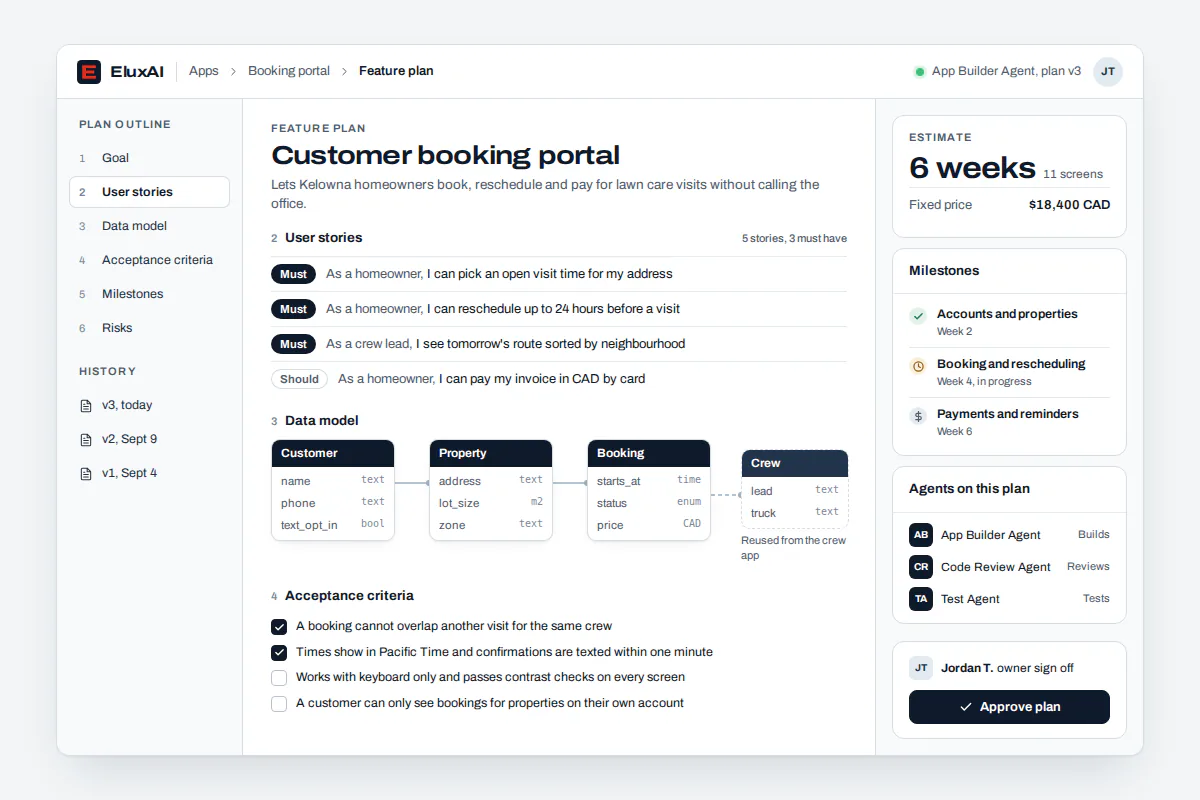
Every change follows the same loop. Agents plan the feature, write the code, review it, run tests and fix failures until the checks pass. The change is committed, packaged and deployed to a private preview environment. A developer or product owner reviews the running feature and approves the merge, and the release is recorded in the audit log.
- Plan. The feature is broken into tasks tied to your spec and approved.
- Build. The builder agent writes the change in your stack and conventions.
- Review. A reviewer agent reads the full diff for logic, readability and risk.
- Test. The build runs and automated tests must pass.
- Fix. Failures go back to the builder, then through review and tests again.
- Preview. The running change is deployed to a private preview environment.
- Approve and release. A person approves the merge, and the release is logged.
Why does AI code review matter before anything ships?
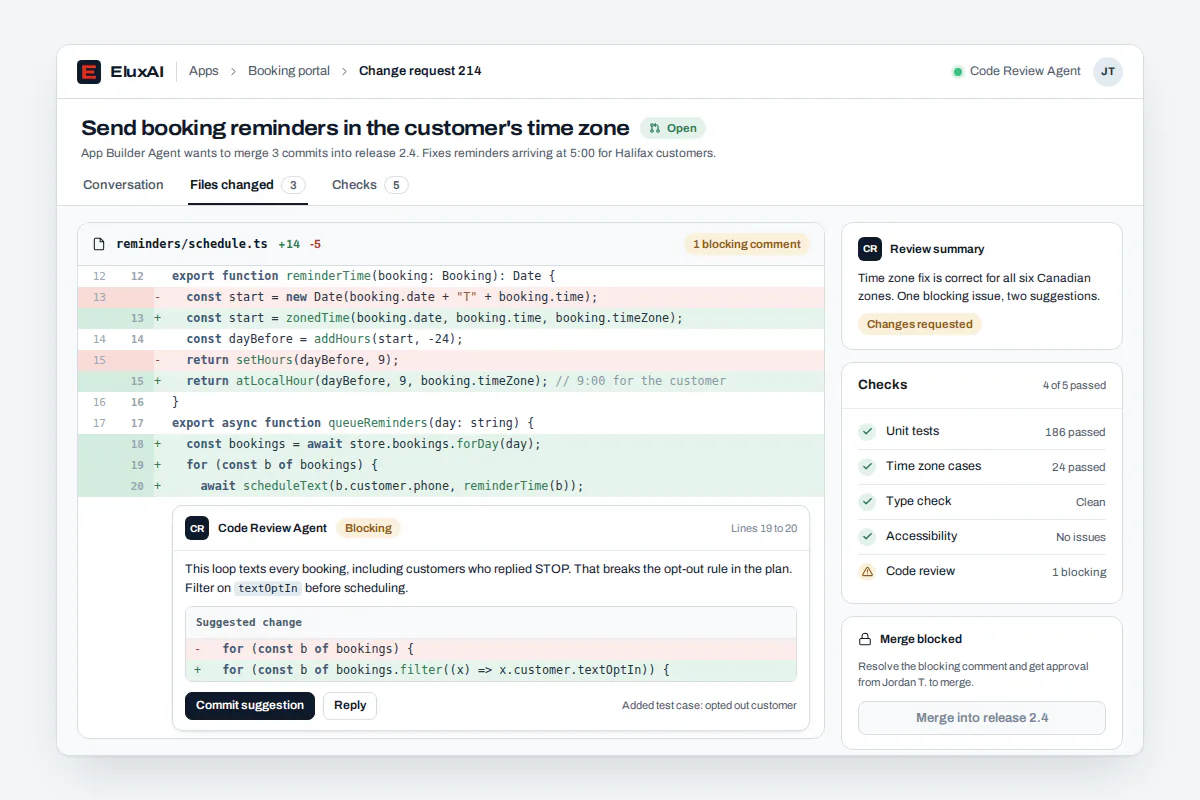
Because AI-written code is not secure by default. Veracode's 2025 testing of more than 100 language models found that 45% of AI-generated code samples introduced OWASP Top 10 vulnerabilities. Newer and larger models did not do better. A separate reviewer and automated tests catch those problems before they reach users, and a human makes the final call.
The Veracode report also found AI failed to defend against cross-site scripting in 86% of relevant samples. Trust is low for good reason. In the Stack Overflow survey, 46% of developers said they distrust the accuracy of AI output, against 33% who trust it.
Google's 2025 DORA research found AI adoption among software professionals reached 90%. About 30% still reported little or no trust in it.
Our reviewer agent checks each change against the OWASP Top 10:2025 risks that matter most for AI code. Those include broken access control, injection, security misconfiguration, software supply chain failures and authentication failures.
The Two-Key Merge: how AI-written code earns its place in production
The Two-Key Merge is our rule that no AI-written change reaches your main branch without two independent keys. The first is a reviewer agent that did not write the code. The second is a person on your team who approves. Seven checks sit behind those keys, so every merge has a clear, auditable reason.
- Spec key: the change maps to an approved plan item.
- Diff review: the reviewer agent reads the full change.
- Security pass: access control, injection, configuration, dependencies and authentication are checked.
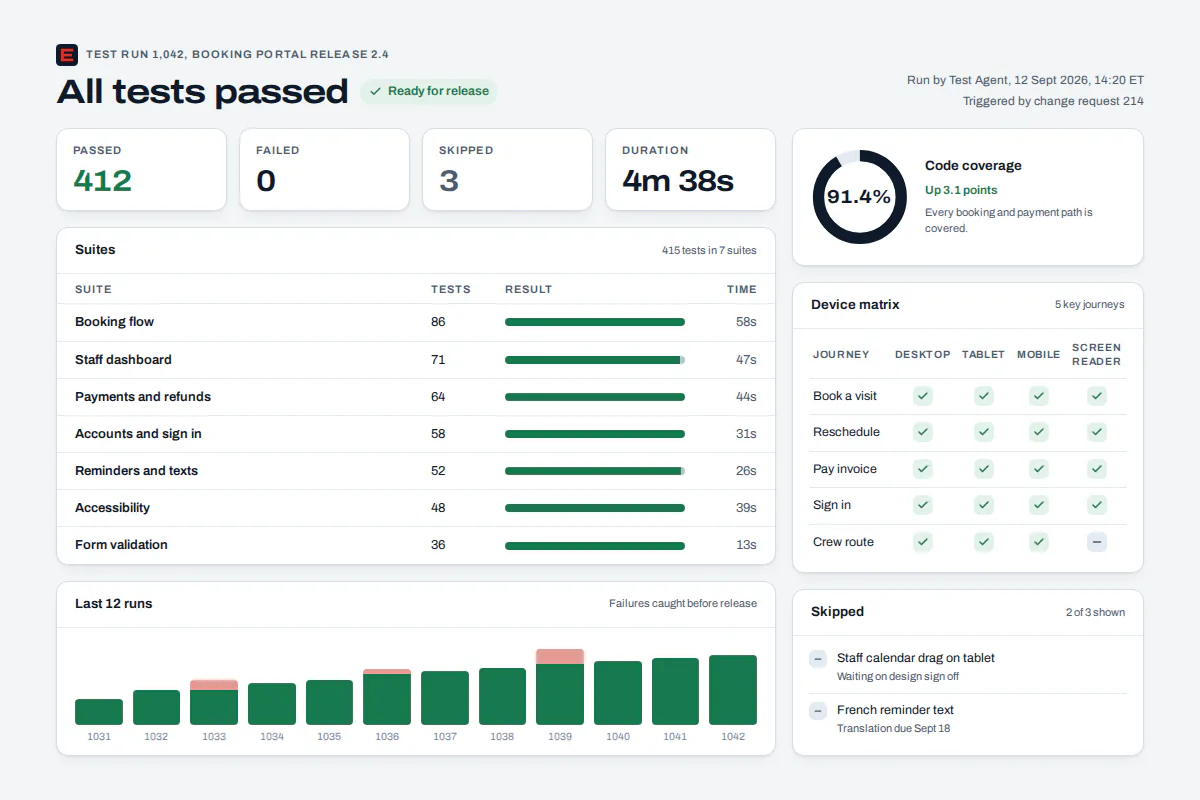
- Test pass: the build succeeds and automated tests run green.
- Fix loop: failures return to the builder and repeat the checks.
- Preview: the running change is visible in a preview environment.
- Human key: a developer or product owner approves, recorded in the audit log.
What is revolutionary is not that AI writes code. It is that no AI-written change merges without two keys, and you can see who turned each one.
What can you build: web apps, PWAs and cross-platform apps?
We build web apps, progressive web apps and cross-platform apps, from internal tools and customer portals to booking systems and SaaS MVPs. We do not run a dedicated native iOS and Android pipeline. For many business tools a progressive web app is enough: it installs on phones and desktops, can work offline and runs from one codebase.
MDN describes a progressive web app as an app built with web technologies that feels like a platform-specific app. Updates ship from the web, so there is no app store review cycle for each release.
Web app development suits work like tenant maintenance portals, quote calculators, client dashboards and staff scheduling tools. If your project truly needs deep native device features, we say so in the assessment rather than stretching a web app past what it does well.
How can app developers and software studios use the agents?
Studios can use the agents as extra engineering capacity inside code they already maintain. The agents read existing structure, conventions and dependencies before changing anything. Common work includes backlog features, refactors, bug fixes and missing test coverage. Senior engineers keep ownership of architecture, code review standards and client relationships, and they decide what merges.
Illustrative example. A small software studio in Waterloo maintains a customer portal for a client and has a long feature backlog. The agents build one feature at a time. The reviewer agent catches a route missing an authorization check before commit. Tests run, the studio lead checks the preview and merges.
- Web and marketing agencies: client portals and booking tools, paired with our AI website builder for the public site.
- SEO agencies: reporting dashboards and internal tools for client work.
- Property management: installable maintenance request apps that feed a ticket desk.
- Clinics and practices: bilingual booking and intake apps designed for privacy.
- Trades and franchises: quote tools, crew job apps and location dashboards from one codebase.
Repeatable operations beyond code, such as ticket triage, run as custom AI agents on the same platform.
Agent build team vs no-code AI app builder vs a development shop
No-code AI app builders are the fastest way to validate an idea. A traditional development shop brings senior people and bespoke architecture at agency rates. EluxAI combines agent speed with engineering discipline: code in your repository, review and tests on every change, and a human approving each merge. The table shows where each option fits best.
| What matters | No-code AI app builder | Development shop | EluxAI agent build team |
|---|---|---|---|
| Built for | Non-coders testing ideas | Large, bespoke projects | Developers, studios and businesses needing production code |
| Where code lives | Vendor platform | Your repository | Your repository, in your stack |
| Code review | Automated scans at best | Senior developer review | Reviewer agent plus human merge |
| Automated tests | Rarely visible | Depends on the shop | Part of every change |
| Mobile | Varies by platform | Native or cross-platform | Web apps, PWAs and cross-platform |
| Preview and approval | In the editor | Staging | Preview environment, approval, audit log |
Verdict: no-code builders are a fast way to test an idea. Once real customer data, payments or integrations are involved, reviewed code in your own repository is the better foundation.
How much does web app development cost in Canada?
Canadian pricing guides published in 2026 put a simple internal web tool at roughly $10,000 to $25,000 CAD. A customer portal, booking platform or dashboard typically runs $25,000 to $60,000, and a multi-user SaaS MVP $50,000 to $120,000. EluxAI quotes after a free assessment of scope, integrations and the review level your app needs.
| Project or rate | Typical market range (CAD) | Source |
|---|---|---|
| Simple internal tool | $10,000 to $25,000 | Databending, 2026 |
| Customer portal, booking platform or dashboard | $25,000 to $60,000 | Databending, 2026 |
| Multi-user SaaS MVP | $50,000 to $120,000 | Databending, 2026 |
| Custom web app or platform in Toronto | $35,000 to $150,000+ | Shift8, 2026 |
| Toronto agency hourly rate | $120 to $250 per hour | Databending, 2026 |
| Annual maintenance | 10% to 20% of build cost | Databending, 2026 |
These are typical market ranges from Canadian agency guides, not EluxAI prices. Looking for an app development company in Canada that shows its review process? EluxAI quotes after a free assessment.
Which Canadian privacy and security rules apply to your app?
If your app collects personal information in commercial activity, PIPEDA applies, or a substantially similar law in Alberta, British Columbia or Quebec. Quebec's Law 25 adds privacy impact assessments for technology projects involving personal information, notice of automated decisions and incident reporting. We design for these from the first sprint, though this page is general information, not legal advice.
- PIPEDA: ten fair information principles, including consent and safeguards, as the Privacy Commissioner outlines.
- Quebec Law 25: penalties reach up to $25 million or 4% of worldwide turnover, according to BLG's compliance guide.
- Security testing: higher-risk apps get AI penetration testing on systems you own and authorize in writing.
- Sensitive specs: internal documentation can live in a private AI knowledge base the agents answer from.
Every build is one part of our AI for business platform. To discuss your own obligations, use our contact page.
Built on NVIDIA: private, high-throughput inference for coding agents
Our agentic system runs on our own NVIDIA GPU server, and we fine-tune models on NVIDIA hardware. When a studio's code is under a non-disclosure agreement, private models on those GPUs keep proprietary source off third-party model services. Canadian hosting is available.
Throughput matters as much as privacy. A planner, builder, reviewer and tester working in parallel only helps if the hardware keeps up. NVIDIA has made this a design priority: its open-source inference software batches many requests together on the same GPUs, the kind of innovation that makes multi-agent coding practical.
NVIDIA describes CUDA as the foundation for GPU computing, and it also publishes open models built for long-running agents. We chose NVIDIA as our innovative foundation because the platform is being built for exactly this kind of agentic work.