What does private AI mean for a Canadian business?
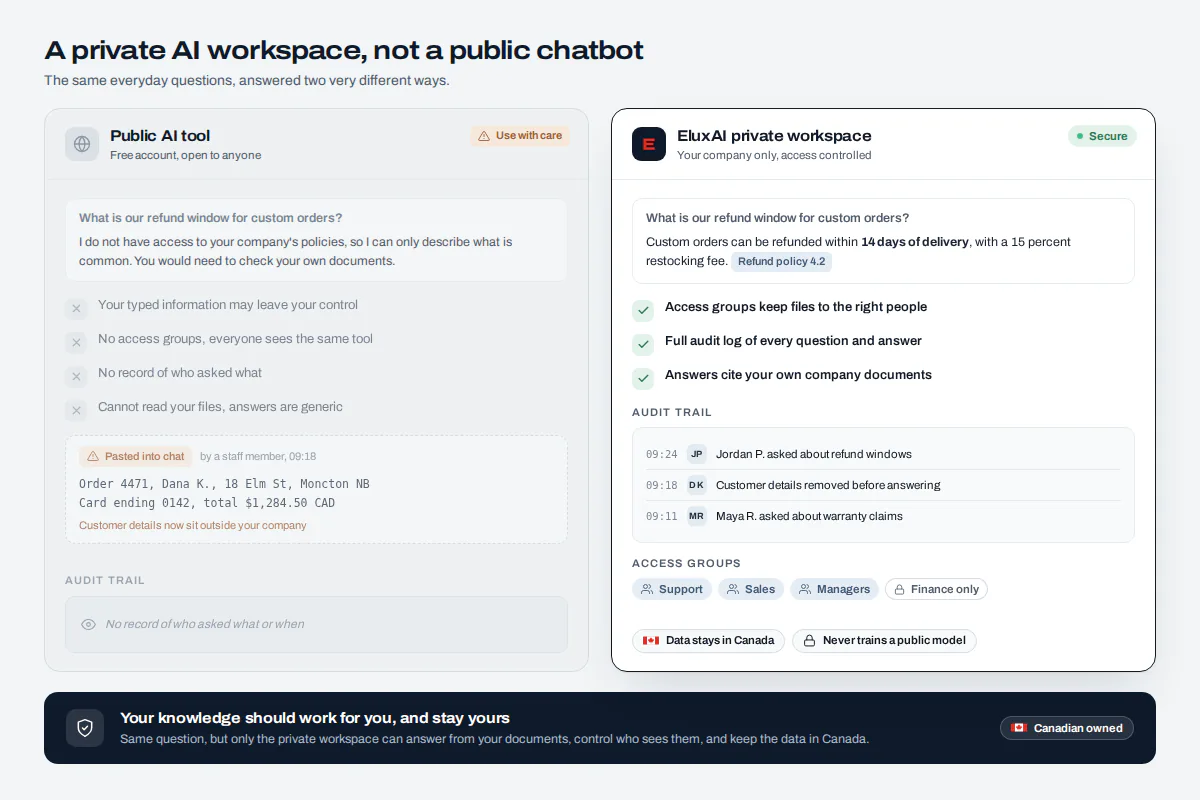
Private AI means using artificial intelligence without handing your data to a public service you don't control. Models run in an environment you choose, documents stay under your access rules, and prompts are not used to train someone else's model. For a Canadian business, it usually means a company knowledge base that staff and AI agents can use with clear limits.
Illustrative example. A law firm in Regina has precedents, intake checklists and policy manuals scattered across shared drives. Associates paste passages into public chatbots to save time, and nobody can say where that text went.
The firm moves those documents into a private workspace. Associates now ask questions and get answers that name the source document. Client files stay with models running on NVIDIA GPUs we operate, and the audit log shows who searched what.
Many Canadian businesses feel this tension. Statistics Canada reports that 13.4% of businesses cited cybersecurity or privacy concerns as a barrier to AI in the second quarter of 2026. Private AI addresses that barrier directly instead of asking staff to ignore it.
What does Canadian privacy law expect when AI reads your documents?
Canadian law does not ban AI, but it keeps you accountable. PIPEDA makes you responsible for personal information you send to a service provider. Quebec's Law 25 requires a privacy impact assessment before personal information leaves Quebec. Canada's privacy regulators have also issued nine principles for generative AI. This is general information, not legal advice.
- Accountability: the Privacy Commissioner's guidelines say an organization remains responsible for personal information transferred to a third party for processing. It must use contracts or other means to protect that information.
- Quebec: Law 25 assessments weigh the information's sensitivity, purpose, safeguards and the destination's legal framework. Penal fines can reach $25 million or 4% of worldwide turnover.
- Generative AI principles: the nine principles cover consent, openness, accountability, accuracy and safeguards, among others.
- Security: the Canadian Centre for Cyber Security warns that users may unknowingly put sensitive corporate data or personal information into AI queries.
Customers care too. In a 2025 survey by the Privacy Commissioner, 88% of Canadians said they are concerned about personal information being used to train AI systems. Only 40% believe businesses respect their privacy rights.
How does an AI knowledge base work?
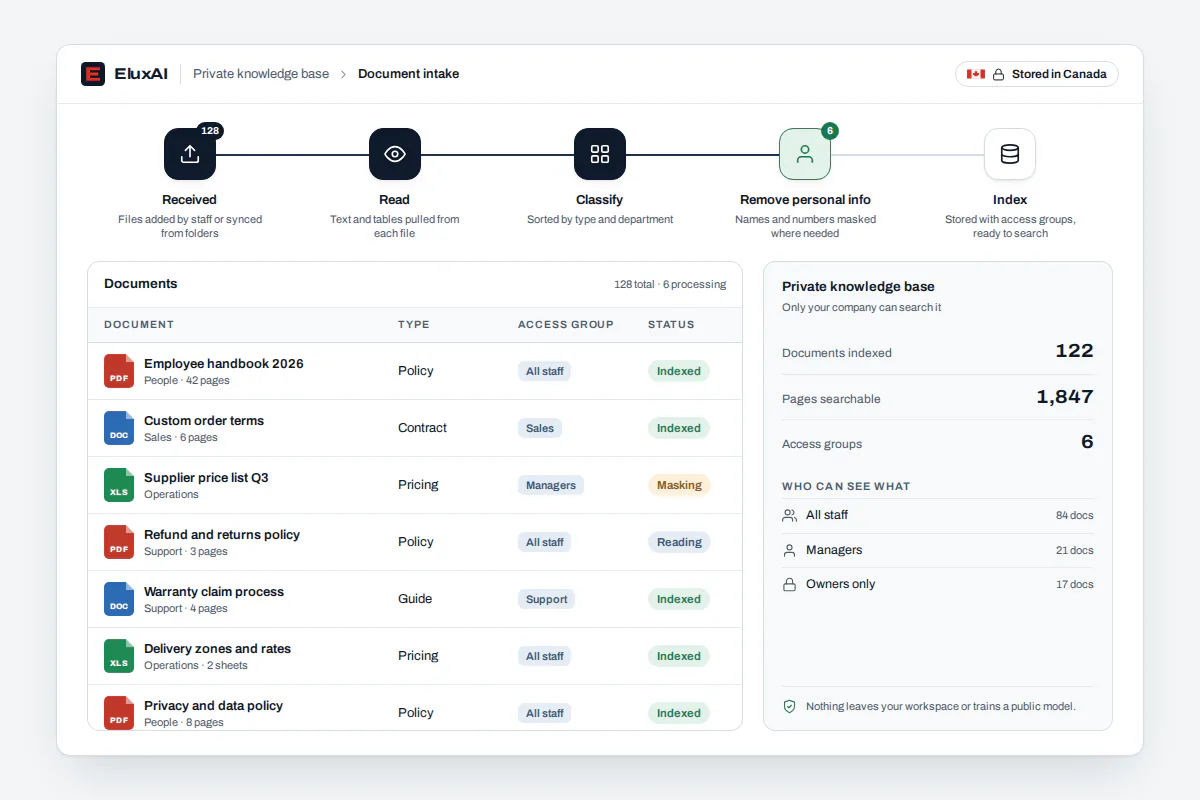
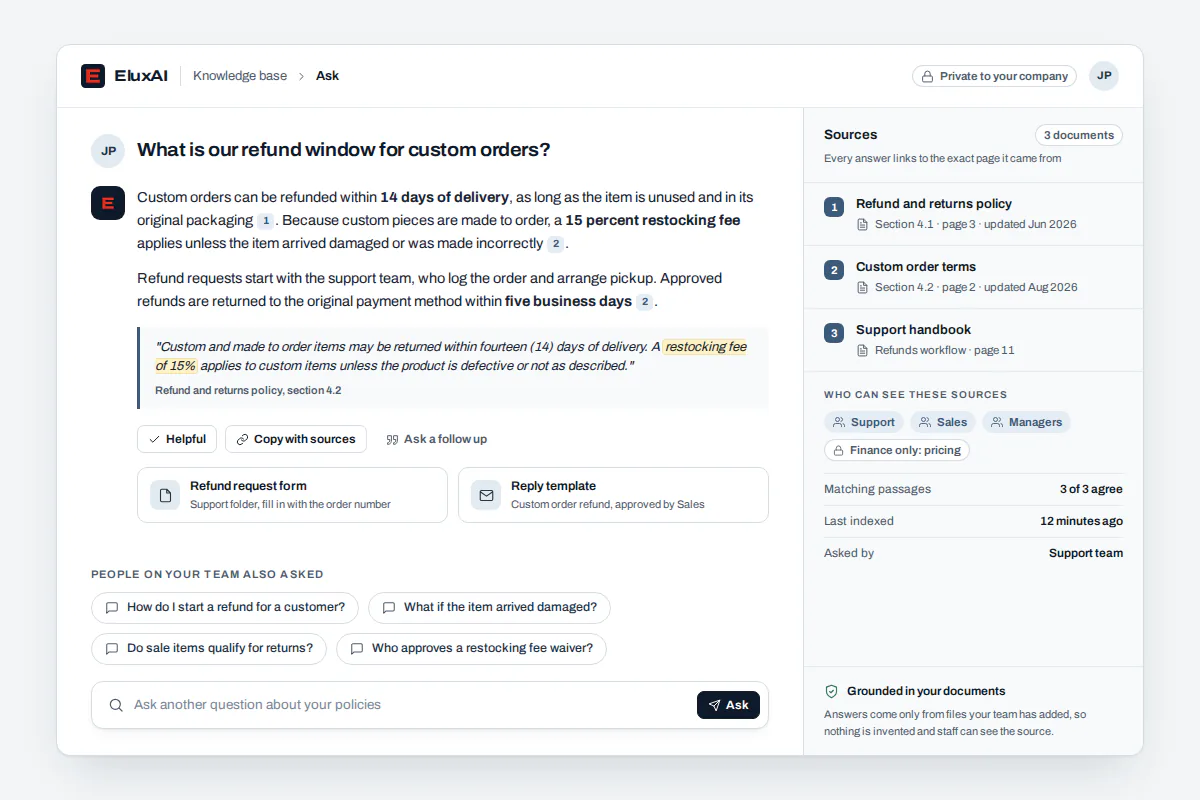
An AI knowledge base turns your documents into searchable company memory. You drop files into a company folder. The platform extracts the text, writes notes for each role and indexes everything so it can be searched by meaning. Agents and approved staff then ask questions and get answers that cite the source, while access rules decide who sees what.
- Collect: drop policies, manuals, price books and templates into your company folder.
- Extract: the platform pulls the text out of each document.
- Distil: it writes notes for each role, so the receptionist sees booking policy and partners see engagement terms.
- Index: everything becomes searchable by meaning, not just keywords.
- Answer: agents and staff get answers that name the source document.
- Act: agents use those answers on calls, texts and email, under your approval rules.
- Log: every question and answer lands in the audit log.
Step six is where most tools stop short. A knowledge base your agents act on, not just a chat box, is the revolutionary difference. Your AI receptionist quotes the same warranty terms as your email replies, because both read from one source.
Private AI vs ChatGPT for business: which fits?
Hosted business AI plans are the fastest start: sign up, add users and chat. A private knowledge base takes longer to set up, but it keeps documents in your own workspace, lets models run on infrastructure we operate and gives every agent the same source. If staff only need writing help, a hosted plan may be enough.
| Option | Where the model runs | Where documents live | Agents act on it | Typical cost |
|---|---|---|---|---|
| Consumer AI chat app | Provider's cloud | Pasted into chats | No | Free to US$200 a month |
| Hosted AI in your productivity suite | Provider's cloud | Your suite, under vendor terms | Limited | Per user, monthly |
| Private enterprise AI platform | Your infrastructure | Your infrastructure | Varies | Enterprise quote |
| Do-it-yourself on-premises build | Your hardware | Your hardware | If you build it | US$80,000+ to build (vendor estimate) |
| EluxAI private AI knowledge base | NVIDIA GPUs we operate, local-first | Your private workspace | Yes, every agent | Quoted after a free assessment |
Verdict: hosted plans are the fastest start. A private knowledge base is the one your agents can safely work from.
How can other AI tools reach your company brain safely?
Approved AI tools connect through a private, per-company connection instead of copied files. Each connection uses an access key that is stored securely, can be limited to approved networks and expires on a date you set. A contractor can query selected knowledge for one project, then lose access automatically when the key expires, without affecting anyone else.
This is where AI integration services earn their keep. Coding assistants, analysts' AI tools and your own agents all read from the same governed source. Nobody emails a spreadsheet of client data to a new tool.
Illustrative example. A software studio in Montreal loads its runbooks and technical documents in English and French. A contractor's AI assistant connects with a key limited to the studio's office network. When the contract ends, the key expires and access stops.
Custom AI solutions build on the same foundation. Studios that ship products for clients can pair the knowledge base with AI software development, so coding agents follow each client's documentation.
The Four Walls test
The Four Walls test is our checklist for testing any privacy claim, including ours. Ask where the model runs, where the data lives, who can reach it and what can leave. An offer that cannot answer all four in writing is not private enough for client data, no matter what its marketing says.
- Wall 1, Model: where does the thinking happen? On NVIDIA GPUs we operate, or with an outside provider you approve in writing.
- Wall 2, Data: where do documents, notes and search indexes live, and who is isolated from whom? Each company has its own private workspace and can export its data.
- Wall 3, Access: who and what can query it? Role-based notes, securely stored keys, approved networks and expiry dates.
- Wall 4, Egress and audit: what can leave, and can you prove what happened? Outbound controls, audit logs, human approvals and a kill switch.
Where data sits depends on the setup you choose. The platform is local-first and can run language, speech and embedding models on Canadian servers, with data residency options. If you pick an outside hosted model for some tasks, those prompts go to that provider under its terms.
How much does private AI cost?
Typical market ranges start at CA$9.20 to CA$28.70 per user a month for hosted AI in a productivity suite. One vendor's 2026 estimates put a simple custom document-search build at US$15,000 to US$25,000, and a fully on-premises enterprise build at US$80,000 or more. EluxAI quotes a private knowledge base after a free assessment.
| Option | Typical market range | Source |
|---|---|---|
| Hosted AI add-on for Microsoft 365 | CA$28.50 per user a month | Canadian pricing guide, 2026 |
| Google Workspace with built-in AI | CA$9.20 to CA$28.70 per user a month | Google Workspace Canada |
| Consumer private AI chat apps | Free to US$200 a month | Consumer app pricing |
| Custom document-search build, simple | US$15,000 to US$25,000, plus US$300 to US$800 a month | 2026 vendor cost estimate |
| Custom build, production | US$40,000 to US$80,000, plus US$1,000 to US$3,000 a month | 2026 vendor cost estimate |
| Enterprise on-premises build | US$80,000 to US$150,000+, plus US$2,000 to US$8,000 a month | 2026 vendor cost estimate |
| One 96 GB NVIDIA workstation GPU | CA$21,599.99 (September 2026 listing) | Canadian retail listing |
These are typical market ranges, not EluxAI prices. Hardware adds up quickly if you build alone. The federal Sovereign AI Compute Strategy commits $2 billion over five years, including up to $300 million to help Canadian businesses buy compute.
Who needs a private AI knowledge base?
Law, accounting and clinic teams can use a private knowledge base to search policies and client files without public chatbots. SEO, marketing and web agencies keep each client's brand rules in a separate workspace. App developers give coding agents governed access to documentation. Franchises and property managers answer every location's calls, texts and email from one source.
- SEO agencies: brand guidelines, service areas and past content keep SEO and content agents on-brand for each client.
- App developers and software studios: client documentation stays governed, and everything exports at contract end.
- Legal, accounting and clinics: client files and policies stay behind role-based access and human approvals.
- Franchises: one operations manual answers every location, so a caller in Barrie and a texter in Kingston get the same warranty answer.
- E-commerce: product specs and return policies power support replies.
The knowledge base sits underneath every agent in our AI for business lineup. It supplies the answers behind our AI email assistant. Routine operations can run as AI agents that draw on the same source. Before connecting sensitive systems, a cybersecurity audit can check your exposure. To scope your own company brain, contact our Canadian team.
Built on NVIDIA: private inference on hardware you can point to
Private AI is only as private as the hardware doing the thinking. Our agentic system runs on our own NVIDIA GPU server, where language, vision, speech and embedding models run and where we fine-tune models. Your knowledge base does not depend on a public chatbot to answer a question.
Memory is what makes capable local models practical. NVIDIA's current workstation GPUs carry 96 GB of error-correcting memory. NVIDIA also states that when its inference microservices are self-hosted, data never leaves your secure enclave.
Protection now reaches data while it is being processed. NVIDIA brought confidential computing to a GPU first, securing data in use. Canada is building on the same innovation: TELUS opened a sovereign AI factory in Rimouski, Quebec, running NVIDIA GPUs on 99% renewable energy. That is the innovative foundation we chose.