What does AI for SEO mean for an agency in 2026?
AI for SEO means two things: using AI to do search work, and getting pages chosen as sources in AI search. EluxAI focuses on the first, for agencies. Our agents audit sites, research keywords, track rankings, draft content and build reports. For the second, Google says pages need no special optimization to appear in AI Overviews.
We are not an SEO agency, and we do not compete with you for clients. We build the agents your agency uses. Each agent has a role, a mission, a schedule and hard limits. It wakes on time, decides what needs doing, uses real tools and routes anything public through your approval.
Google's guidance is plain. Its documentation on AI features in Search says there are no additional requirements to appear in AI Overviews or AI Mode. A page must be indexed and eligible to show with a snippet, which makes solid technical SEO more valuable, not less.
What do the SEO agents do every day, week and month?
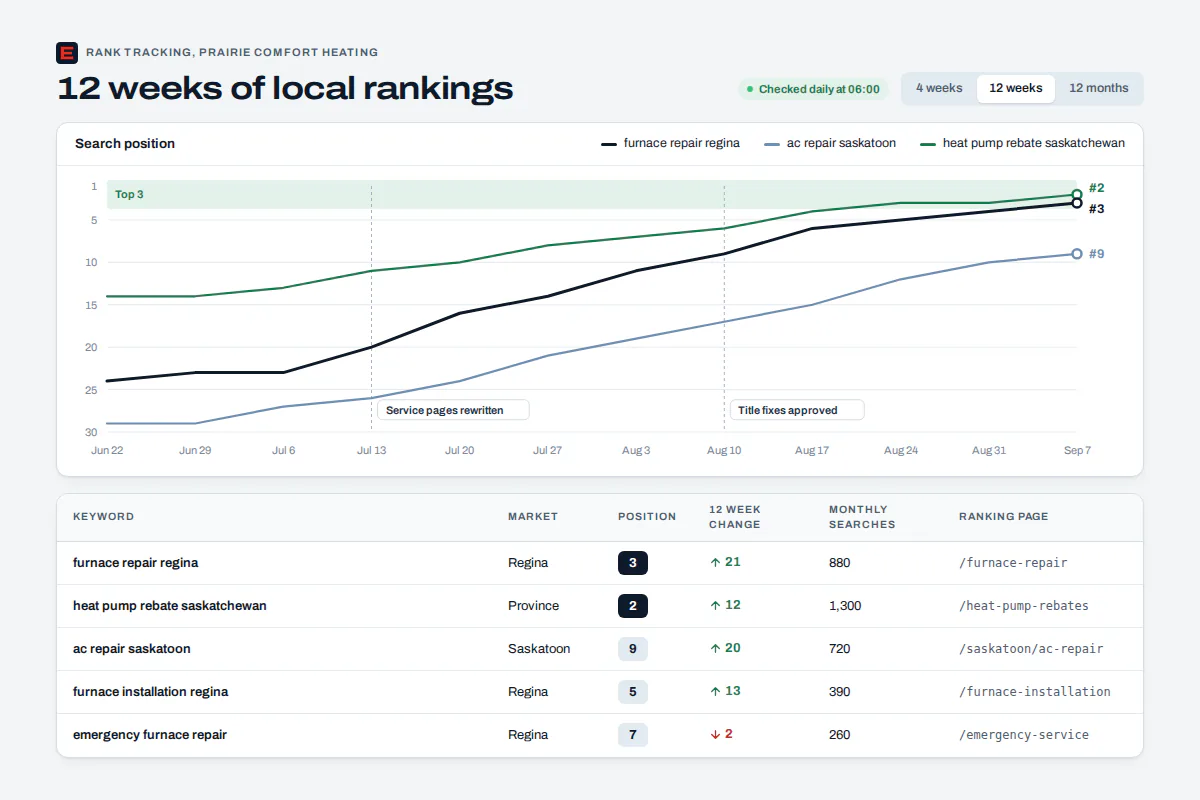
The agents run routines on a schedule for each client. Daily, they watch rankings and flag drops. Weekly, they audit technical health and check new pages. Monthly, they refresh keyword research, plan content and build agency-branded reports. Each routine has an approval point, so strategists see fixes, posts and reports before anything reaches a client or a live site.
| Routine | Typical schedule | Output | Approval point |
|---|---|---|---|
| Rank and competitor tracking | Daily | Movement alerts and competitor changes | Strategist reviews alerts |
| Technical audit | Weekly | Health score and ranked issues | Strategist approves the fix list |
| Keyword research | Monthly | Opportunities grouped by topic | Strategist picks targets |
| Content calendar and drafts | Monthly | Calendar and first drafts | Editor approves each post |
| Links and directory listings | Ongoing | Submissions tracked until live | Account lead approves outreach |
| Client report | Monthly | Branded PDF and spreadsheet | Account manager approves the send |
How does white label SEO delivery work, one workspace per client?
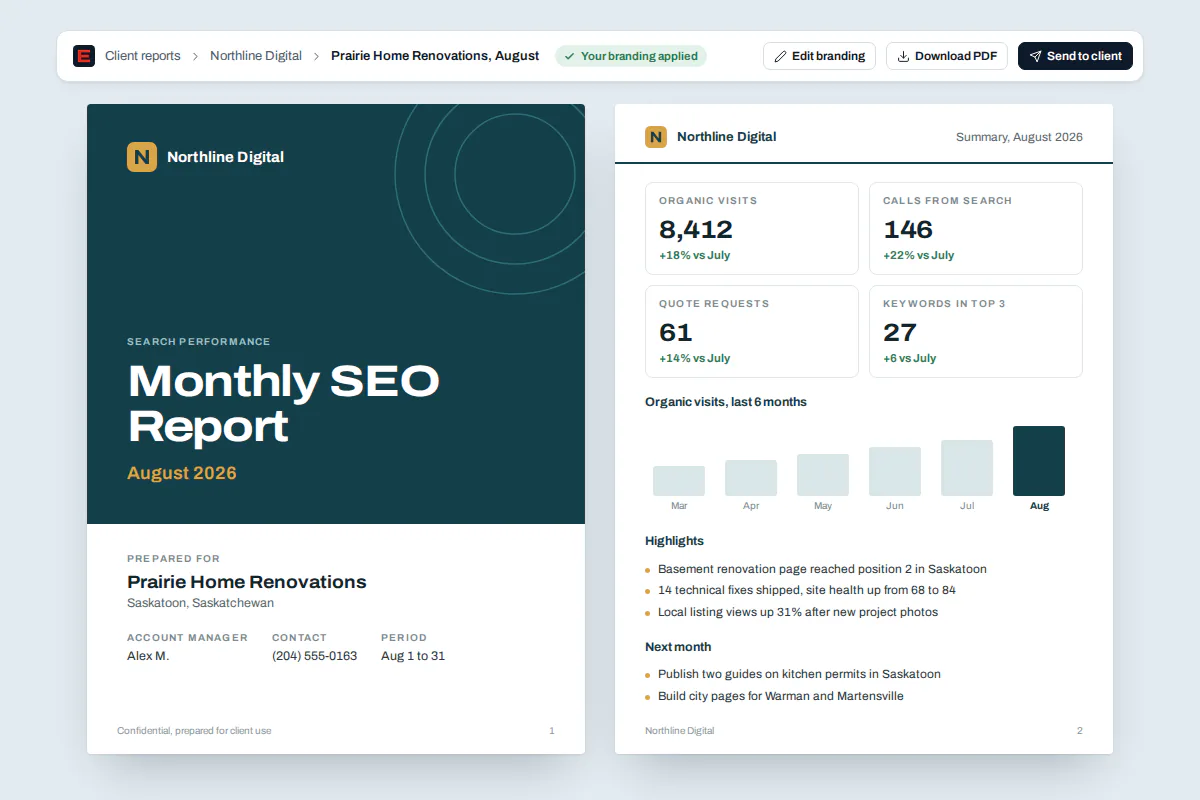
Each client gets a private workspace with its own data, agents, rules and history, so nothing crosses between accounts. The agents do the audit, tracking, content and link work, then produce monthly PDF and spreadsheet reports under your agency's brand. Your team reviews and sends them. Clients see your agency, and your strategists keep the relationship.
Illustrative example. On the first business day of each month, the reporting agent in every client workspace of a Vancouver SEO agency wakes up. It pulls Search Console, rank tracking and analytics data and builds each report in the agency's branding. Account managers add a strategy note and approve the send, instead of copying numbers.
Google introduced 16 months of Search Console performance data, so year-over-year comparisons can appear in every report.
How do technical audits turn into fixes instead of reports?
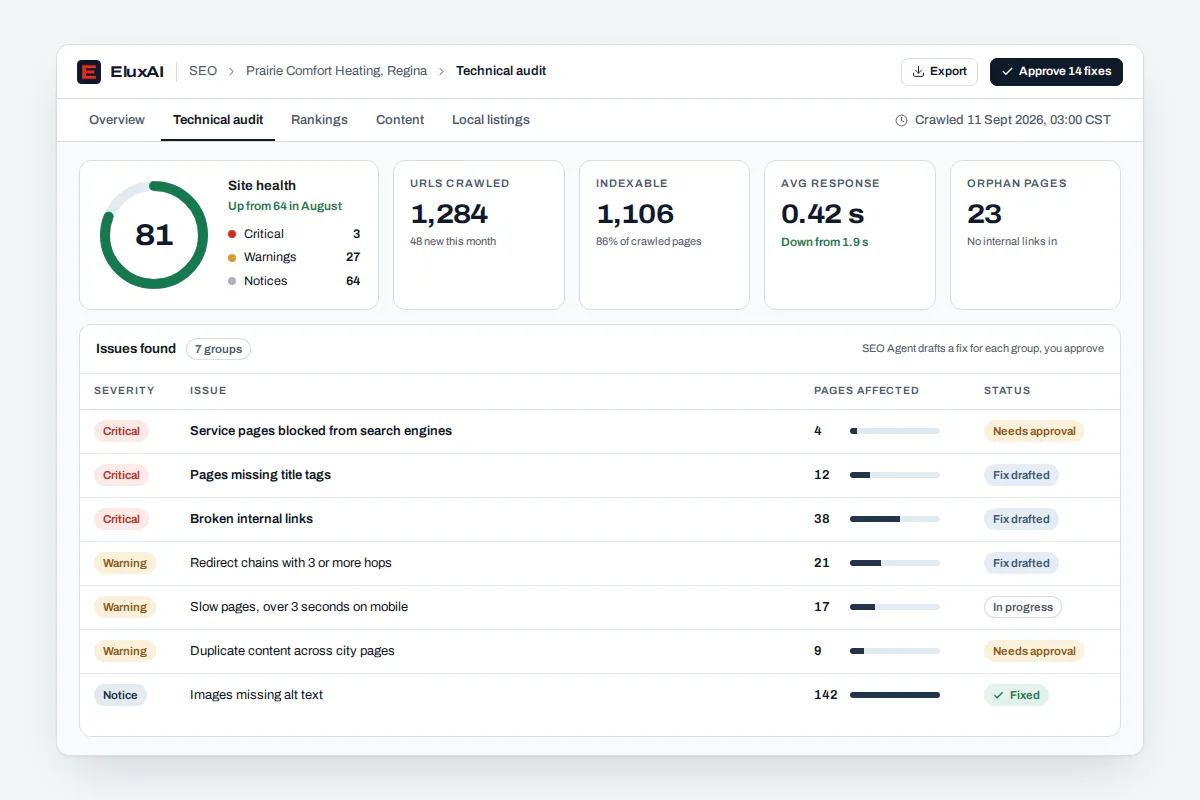
A scheduled audit combines Search Console data, page speed and accessibility checks and market ranking data into a health score and a ranked issue list. When the site's code is connected, the agents prepare the fix, your team approves it, and it deploys. The next audit confirms the issue is gone. A report that only lists problems is half a job.
Speed issues are measured against Google's Core Web Vitals. Pages should show main content within 2.5 seconds, respond to input within 200 milliseconds and keep layout shift at 0.1 or less.
Illustrative example. A marketing agency's HVAC client in Edmonton has slow mobile service pages and no structured data. The audit agent flags both. The agents prepare changes on the connected site, the agency approves, and the fix deploys. The sitemap refreshes, and Search Console confirms Google can see the pages.
When a site needs more than fixes, a website redesign runs through the same approval process.
Can AI-drafted content and link building stay inside Google's rules?
Yes, when people stay in charge. Google accepts AI-assisted content that is helpful and accurate, but using AI to generate many pages without adding value can break its scaled content abuse policy. Our agents plan a calendar and write first drafts, and an editor approves every post. Link work is tracked to live, and no links are ever bought.
- Content: Google's generative AI guidance also suggests explaining how content was created where that helps readers.
- Links: Google's spam policies treat buying or selling links, including trading goods or services, as link spam.
- Reviews: the Competition Bureau says businesses should not write, commission or publish fake reviews.
Promotion of new content on social channels and email is handled by our AI marketing agents.
What actually gets pages indexed: sitemaps, Search Console or instant notifications?
For Google, current sitemaps, strong internal links and Search Console do the work. Google's Indexing API only covers job posting and livestream pages. For Bing and several other engines, the agents send instant indexing notifications whenever pages change, and one notification is shared across participating engines. Google is not a listed participant, so we never promise faster Google indexing.
Google's Indexing API documentation limits it to pages with job postings or livestream events. Bing is among the participating engines for instant notifications.
The Audit-to-Live Loop: how every client workspace runs each month
The Audit-to-Live Loop is the five-stage cycle our SEO agents repeat for every client: detect, decide, do, declare and demonstrate. It connects the audit to real fixes, the fixes to indexing, and the results to the report. The revolutionary part is that the whole loop runs inside your agency, under your approval, on schedule.
- Detect: a scheduled audit produces a health score and issue list.
- Decide: issues are ranked by the impressions they touch and the effort to fix, and a person approves the priorities.
- Do: agents apply approved fixes, draft content and submit listings through the approval gate.
- Declare: sitemaps update, participating engines are notified, and key pages are checked in Search Console.
- Demonstrate: the monthly report shows fixes shipped, links live, rank movement and outcomes from tagged campaign links.
SEO agents vs AI SEO tools vs outsourced white label SEO
AI SEO tools give your team data and a to-do list, and your staff still do the work. Outsourced white label SEO vendors do the work, often where you cannot see it. EluxAI's agents do the work inside your agency's workspaces, under your approval, with an audit log and your brand on every report.
| What matters | AI SEO tools | White label vendor | EluxAI SEO agents |
|---|---|---|---|
| Who does the work | Your staff | The vendor's staff | Agents on a schedule, with your approval |
| Technical fixes | A to-do list | Sometimes | Applied to connected sites after approval |
| Content | Writing assistant | Outsourced writers | Calendar and drafts, editor-approved |
| Link building | Prospecting data | Methods vary | Tracked to live, no paid links |
| Reporting | Tool exports | White label reports | Branded PDF and spreadsheet per client |
| Oversight | You run it | Limited visibility | Approval gate and audit log |
Verdict: tools hand you a to-do list, and vendors work where you cannot see. Agents do the work in your workspace, under your approval, with your brand on the report.
How much do SEO retainers and white label SEO cost in Canada?
A 2026 Canadian pricing guide puts entry-level local SEO retainers at $750 to $1,500 CAD per month and small to mid-sized programs at $1,500 to $3,500. White label wholesale for starter local SEO runs about $399 to $545 USD per client per month in one 2026 agency guide. EluxAI quotes after a free assessment of your client mix.
| Service | Typical market range | Source |
|---|---|---|
| Entry-level local SEO retainer | $750 to $1,500 CAD per month | SEO Team Toronto, 2026 |
| Small to mid-sized retainer | $1,500 to $3,500 CAD per month | SEO Team Toronto, 2026 |
| One-time technical SEO audit | $1,500 to $5,000+ CAD | SEO Team Toronto, 2026 |
| White label wholesale, starter local | $399 to $545 USD per client per month | ALM Corp, 2026 |
| White label wholesale, national | $699 to $2,000+ USD per client per month | ALM Corp, 2026 |
| Healthy gross margin on resold SEO | 40% to 60% | ALM Corp, 2026 |
These are typical market ranges, not EluxAI prices. The Ahrefs pricing survey of 439 providers found 79.1% of U.S. and Canadian providers charge at least $1,001 USD per month.
How do the agents handle local SEO services and bilingual sites?
Local SEO services run as their own routine: directory submissions tracked until each listing is live, location pages, local rank tracking and structured data. For Quebec clients, the agents draft French and English versions, an editor on your team approves both, and language tags link the pairs so Google shows the right version. Analytics on Quebec sites respect Law 25 consent rules.
- French versions: Quebec treats websites as commercial documents that must be available in French, as the CFIB explains.
- Language tags: Google's localization guide says each version must reference the others both ways.
- Consent: under Law 25, tracking technologies stay off until a visitor agrees, so reports note consent-limited data.
Illustrative example. A Quebec City marketing agency runs a bilingual clinic client. The agents draft both language versions, an editor approves each post, and directory listings are tracked until live. No paid links and no incentivized reviews.
Who are the SEO agents built for?
SEO agencies are the main audience, with every client in a private workspace. Marketing and web agencies can use the agents to add an SEO service line without hiring a full team. App developers can use them for product and documentation sites. In-house teams at trades businesses, clinics, property managers, retailers and franchises can use them for local and technical SEO.
Demand is growing in the sector that includes most agencies. Statistics Canada reports that 32.4% of businesses in professional, scientific and technical services used AI in the second quarter of 2026.
SEO agents are one part of our AI for business lineup. Routines beyond search can run as custom AI agents. Our team answers questions through the contact page.
Built on NVIDIA: private, on-schedule inference for every client workspace
Agencies hold client data under non-disclosure agreements. Our agentic system runs on our own NVIDIA GPU server, and language and embedding models run on NVIDIA GPUs. That means Search Console exports and unpublished drafts can stay off third-party model services, with Canadian hosting available.
Embeddings are how agents group large keyword sets by meaning. NVIDIA's own documentation for its embedding microservices lists semantic search, classification and clustering tasks such as topic discovery. That is the work behind topic clusters and content gap maps.
Accelerated computing also lets the routines in every client workspace finish on schedule. NVIDIA describes CUDA as the foundation for GPU computing, and that ecosystem is the innovative foundation we chose to build on.