What are AI marketing tools, and where do marketing agents fit?
AI marketing tools are software that uses artificial intelligence to help with a marketing task, such as writing a caption, creating an image or scheduling a post. Most do one step and then wait for you. Marketing agents run the whole program: they plan, create, publish, reply and report every day, and they stop for your approval wherever the brand is exposed.
Popular roundups of AI marketing tools list dozens of products, one per job. Somebody still moves the work between them, and that somebody is usually the owner at 10 p.m.
What is revolutionary is the shift from ten separate tools to one team of agents. That team plans the calendar, creates posts, publishes on schedule, answers comments and sends your newsletter, all under one set of approval rules and one audit log. It is the same agentic approach behind every service in our AI for business lineup.
The appetite is already here. Among Canadian businesses using AI in the second quarter of 2026, 19.8% applied it to marketing automation, according to Statistics Canada. The next step is automation that also knows when to stop and ask.
What does an AI marketing agent do in a normal week?
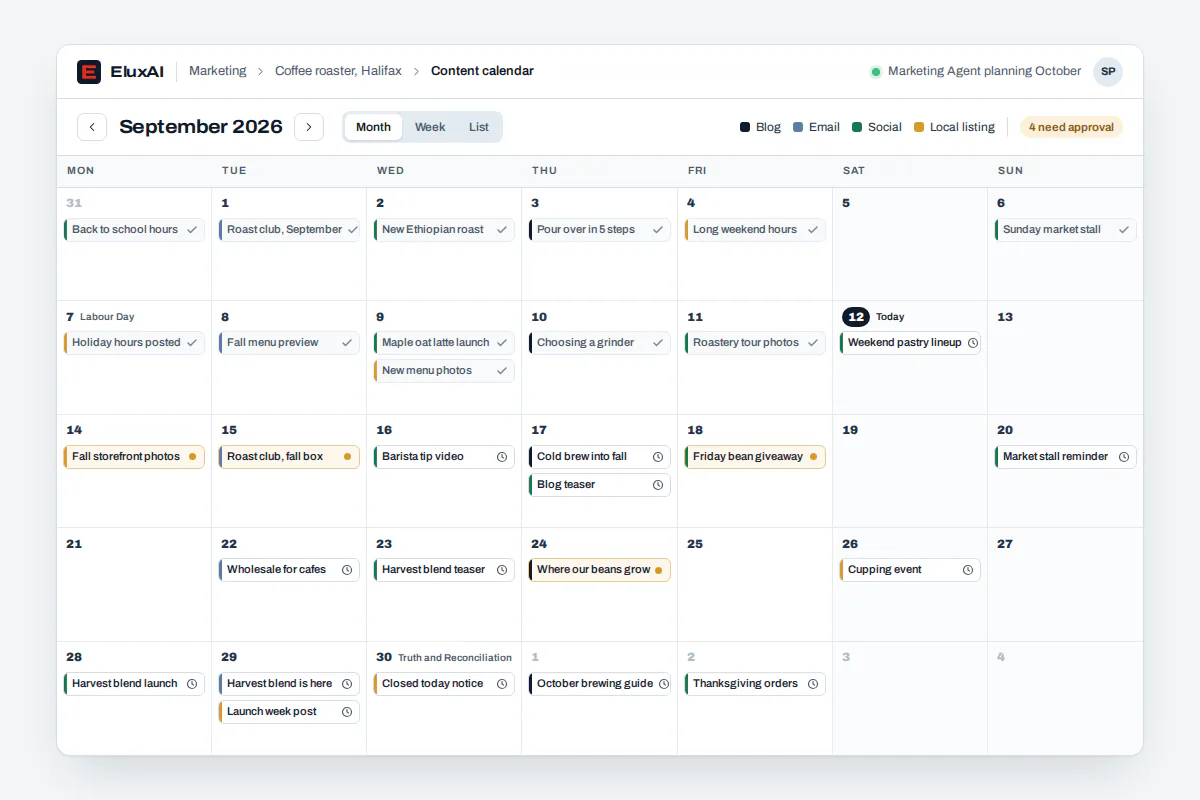
A marketing agent works through the same loop every week. It drafts a content calendar from your goals and brand notes, creates the posts and images, queues them for approval, publishes on schedule, answers comments and direct messages, and reports on what worked. You spend minutes approving instead of hours producing, and nothing reaches your audience without passing your rules.
- Plan. Reads your brand notes and upcoming dates, then proposes a calendar for each platform.
- Create. Writes captions in your brand voice and creates a matching image for each post.
- Check. Runs every draft through the Seven-Check Post Gate described below.
- Approve. Sends anything that needs a person to your approval queue, on your phone or desktop.
- Publish. Posts on schedule, within each platform's daily cap.
- Respond. Answers comments and DMs, and hands sales leads or complaints to a person.
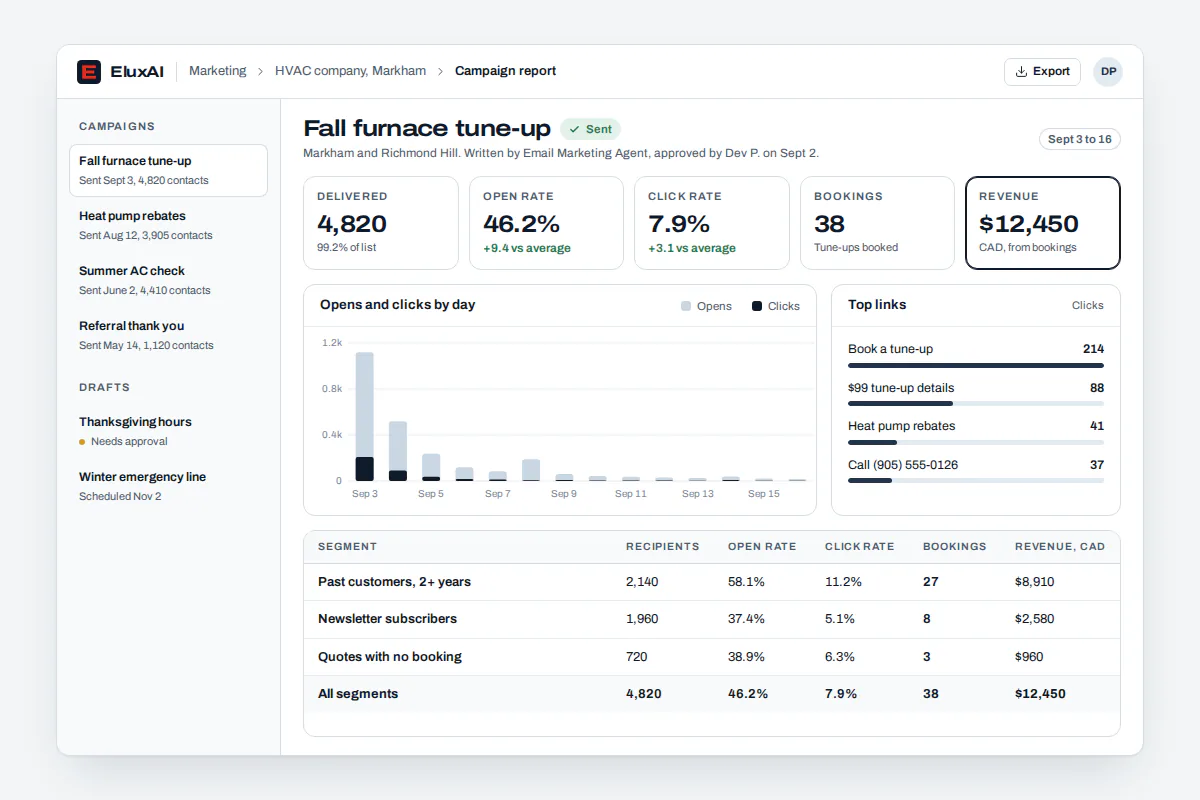
- Report. Summarizes reach, clicks and replies so next week's plan starts from real results.
Example scenario, illustrative only: a home renovation company in Surrey, British Columbia wants steady before-and-after posts. Agents plan two posts a week for Instagram, Facebook Pages and Pinterest and queue each one for the owner to approve from a phone. When someone sends a DM asking for a quote, the agent collects the address and project type and opens a ticket for the office.
If that lead would rather text than message on Instagram, our AI business texting agent picks up the conversation with the same context.
Which social platforms can the agents manage, and what rules apply?
Our agents publish and reply on Reddit, X, LinkedIn, Facebook Pages, Instagram, Threads, Bluesky, Pinterest, Tumblr and Mastodon. Every network sets its own automation rules, so each channel is set up separately. X requires explicit consent before automated replies or direct messages. Facebook, Instagram and Threads show AI info labels on content identified or disclosed as AI-generated.
An AI social media manager on ten networks follows ten rulebooks, platform limits first.
| Platform | Typical use | How the agents handle it |
|---|---|---|
| Company updates, hiring, case studies | Posts held for approval by default; comment replies drafted for review | |
| X, Threads, Bluesky, Mastodon | Short updates and conversation | Replies only where the platform's consent rules allow; daily caps per account |
| Facebook Pages, Instagram | Local promotions, events, visuals | Created images disclosed where they could mislead; DMs answered or routed to a person |
| Pinterest, Tumblr | Visual inspiration and evergreen content | Scheduled pins and posts that link back to your website |
| Community answers and announcements | Drafts only, always approved by a person and matched to each community's rules |
Verdict: one set of approval rules, adjusted for each network, beats ten logins and ten sets of habits.
The consent rule for automated replies comes straight from the X developer policy. The labelling approach on Facebook, Instagram and Threads is explained on the platform's transparency page.
How do approvals, brand-safety checks and daily caps protect your brand?
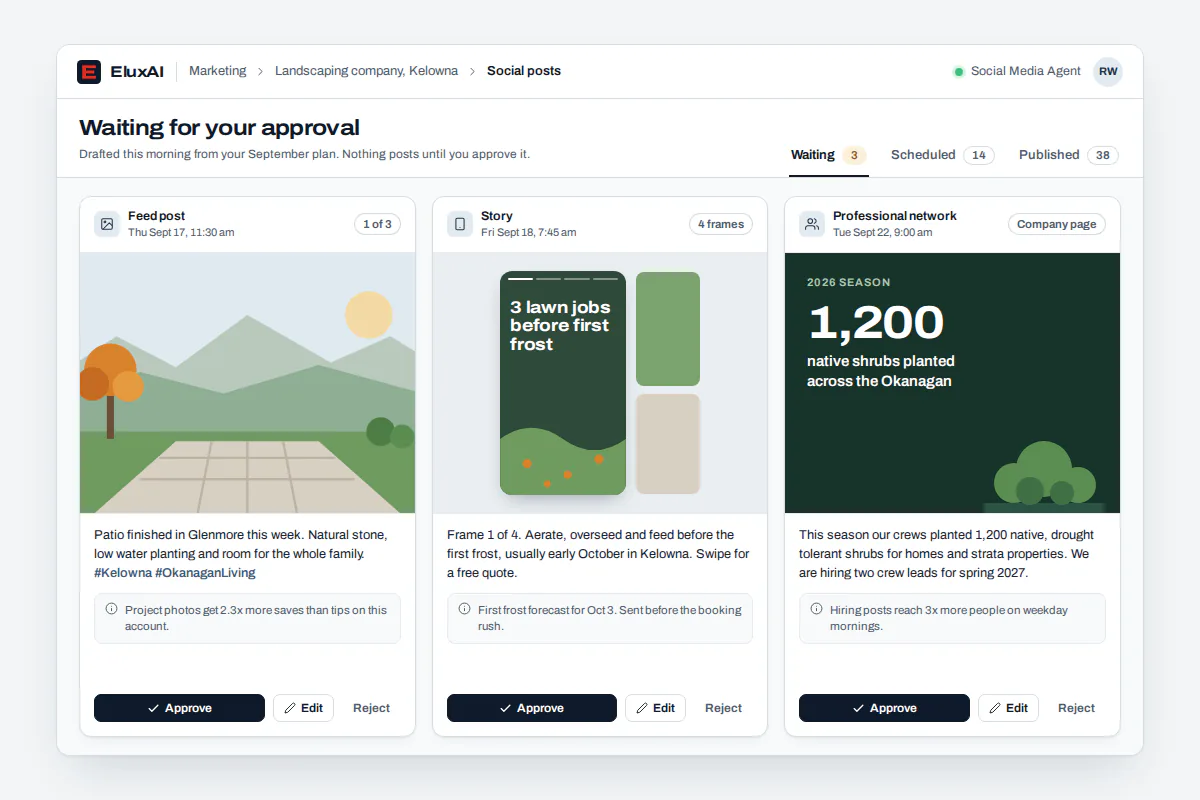
Every post, reply, DM and email passes the same seven checks before anyone outside your business sees it. Content that fails a check is held, and content that needs a person goes to your approval queue. New accounts start with approval required for everything, and you relax that only for low-risk post types once the results have earned your trust.
What makes this approach revolutionary is that compliance is part of the workflow, not a clean-up job after something goes wrong. We call it the Seven-Check Post Gate:
- Consent. Is there consent for this email or DM, and has the person not opted out?
- Voice. Does it sound like you, based on the brand notes stored in your company knowledge base?
- Safety. Did brand-safety screening flag anything? Flagged content is always held.
- Truth. No invented claims, fake reviews or fake endorsements, and created images are disclosed where they could mislead.
- Cap. Is this platform still under today's limit for posts and replies?
- Approval. Does this type of content need a person's sign-off at your current trust level?
- Record. Is the action in the audit log, and does every email carry your identity and a working unsubscribe?
The truth check matters more every year. When the Competition Bureau consulted Canadians on AI, over a third of submissions raised its implications for deceptive marketing, including fake online reviews and endorsements, as the Bureau's summary shows. Our agents never create testimonials.
How does AI email marketing stay CASL compliant?
Canada's Anti-Spam Legislation applies to commercial messages whether a person or an AI wrote them. You need consent, clear sender identification and a working unsubscribe. Our email agents run signup forms, lists, drip sequences and campaigns, record where each consent came from, and add a one-click unsubscribe that takes effect right away, well inside the legal deadline.
Under section 11 of CASL, an unsubscribe must take effect no later than 10 business days after the request, and the link must keep working for at least 60 days. The maximum administrative penalty for a business is $10 million per violation.
The law's definition of an electronic address includes instant messaging and similar accounts, so promotional direct messages on social platforms can fall under it too. That is why our consent check covers DMs, not only email.
Good email marketing services also protect your domain. The Canadian Centre for Cyber Security recommends email domain protection settings that tell receiving mail systems to reject messages pretending to be you. We check those settings before your first campaign goes out.
Example scenario, illustrative only: a bilingual kitchenware shop in Quebec City adds a signup form that records consent and its source. New subscribers get a welcome sequence in French or English, then a monthly campaign with open and click tracking. Replies to those campaigns land with our AI email assistant, so no customer question sits unanswered.
AI marketing tools vs a social media agency vs marketing agents
Single AI marketing tools are inexpensive but leave the coordination to you. A social media agency does the coordination, usually during business hours and on a few platforms. Marketing agents combine the two: they do the daily work across every channel you use, and your team keeps the final say through approvals, caps and an audit log anyone can read.
| Question | Single AI marketing tools | Social media agency or freelancer | EluxAI marketing agents |
|---|---|---|---|
| Who does the posting | You | Agency staff | Agents, after approval |
| Platforms covered | Usually one per tool | Usually a few | Up to ten social networks |
| Replies to comments and DMs | Rarely | Business hours | Around the clock, with approval levels |
| Approvals and brand-safety holds | Not built in | Informal | Built in, with daily caps |
| Email campaigns | Separate subscription | Often a separate retainer | Signup forms, sequences, campaigns, one-click unsubscribe |
| CASL consent records | Your job | Varies | Tracked for every contact |
| Images for posts | Separate tool | Designer time | Created for each post |
Verdict: tools help you do a task, an agency does the work on its schedule, and agents do it every day inside rules you set.
How much do AI marketing tools and managed marketing cost in Canada?
Typical Canadian market ranges run from about $500 a month for a freelancer to $20,000 or more for a full-service agency. Managed email marketing for a small business usually adds $1,500 to $4,000 a month before platform fees. These are market ranges, not our prices. EluxAI quotes after a free assessment of your channels, volume and approval needs.
| Service | Typical market range | Source |
|---|---|---|
| Social media management, freelancer | $500 to $2,500 | Canadian pricing guide, 2026 |
| Social media management, boutique agency | $2,000 to $10,000 | Same guide |
| Social media management, full-service agency | $5,000 to $20,000+ | Same guide |
| Social media management, in-house team | $4,500 to $15,000+ | Same guide |
| Managed email marketing, small business | $1,500 to $4,000, platform fees extra | Canadian email cost guide, 2026 |
What moves a quote: the number of platforms, how many posts and replies you want each week, whether every post needs a new image, the size of your email list, and how much approval you want to keep. EluxAI quotes after a free assessment, and you can talk to our Canadian team before sharing any account access.
Who are AI marketing agents built for?
Agencies and busy owners stand to gain the most. SEO agencies can add social and email to existing retainers without hiring. App developers can announce launches and run waitlist emails. Marketing agencies manage many clients from private workspaces with separate approval queues. Trades, clinics, property managers, online stores and franchises can use them to stay visible every week without adding staff.
- SEO agencies. Add AI content creation and social posting to client retainers. Content calendars can build on keyword research from our AI for SEO agents.
- App developers and software studios. Launch announcements across X, Bluesky, Mastodon, Reddit and LinkedIn, plus waitlist signup forms and onboarding sequences.
- Marketing and web agencies. Run an AI marketing agency model: each client gets a private workspace, its own brand voice, approval queue and daily caps.
- Trades and home services. Before-and-after posts, quote requests from DMs turned into tickets, and seasonal email campaigns.
- Clinics and professional practices. Conservative approval levels and general educational posts rather than testimonials.
- Property managers, online stores and franchises. Vacancy and product posts, tenant or customer newsletters, and head office templates with location-level caps.
New site on the way? Pair these agents with our AI website builder so every post points somewhere worth landing.
Built on NVIDIA: creative work in seconds, kept private
We chose NVIDIA accelerated computing as the innovative foundation for our agentic platform, and marketing is where you feel it. Creating images is heavy work for a computer. NVIDIA reports that its latest-generation GPU, using 4-bit precision, generated an image in 3.85 seconds versus 10.62 seconds on the previous generation.
Speed changes the experience for you. When an image takes seconds, an agent can offer three options for a post instead of one, and approving becomes a quick glance on your phone.
Running on NVIDIA GPUs also means unreleased campaign material can stay on our own NVIDIA-powered hardware, not a shared public AI service.