What does AI for research look like when agents do the reading?
AI for research has mostly meant a tool that answers when you ask. Research agents act without being asked. They search for new publications on a schedule, read what they find, decide what fits your scope and write a cited summary for a person to review. The routine runs day and night, so your team starts each week already informed.
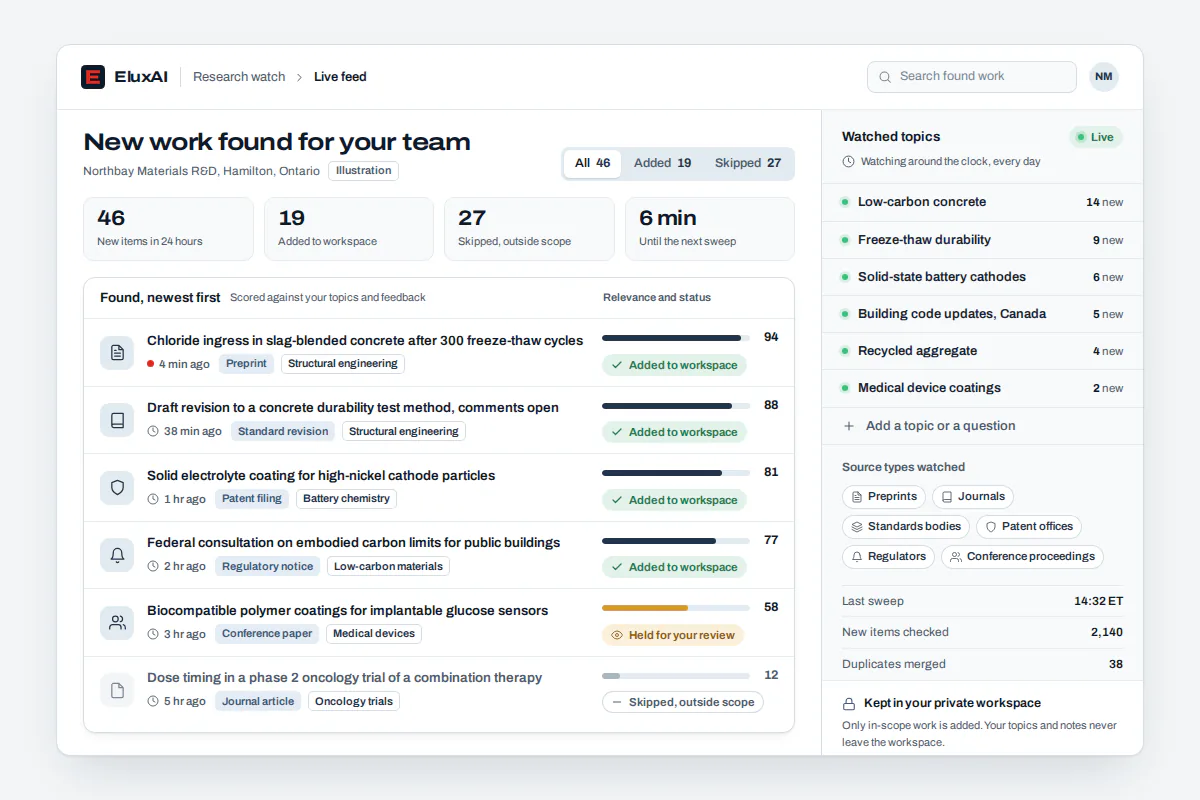
Illustrative example. A materials engineering team in Hamilton is testing low-carbon concrete for bridge decks. One engineer used to spend Friday afternoons skimming journal alerts and standards notices, and still missed a draft test-method change until a supplier mentioned it.
With research agents, the watch never pauses. The draft amendment is flagged the day it appears, with the changed clause quoted. On Monday the project lead approves a two-page brief instead of assembling one from scratch.
That is the difference between an AI research assistant and an agentic system. An assistant waits for a prompt. An agent owns a job, keeps a routine and hands a person the decisions that matter. It runs on the same platform as the rest of our AI for business lineup.
How do research agents find new work as soon as it appears?
Research agents check the sources your field depends on every few minutes, around the clock. New items are compared with what the workspace already holds, duplicates are dropped and anything outside your scope is skipped with a reason. What remains is read, summarized and filed under the right topic, so relevant work reaches your team while it is still new, not at the next scheduled search.
- Research literature: journal articles, preprints, conference proceedings and theses as they are published.
- Standards and codes: revisions, drafts open for public comment and withdrawn editions.
- Patents: new filings and grants in the technology areas you choose.
- Regulatory and funding notices: guidance updates, safety communications and calls for proposals.
- Industry sources: technical reports, manufacturer documentation and market studies.
The volume keeps climbing. The US National Science Foundation counted 3.3 million science and engineering articles worldwide in 2023, up from 2.2 million in 2014. No team can read that much, but a watch scoped to your field can keep up with its share.
Pages the agents have already read are rechecked for changes, and only the changed parts are updated. A corrected article or revised standard replaces the old version instead of sitting quietly beside it.
How do the agents learn your field and your team's judgement?
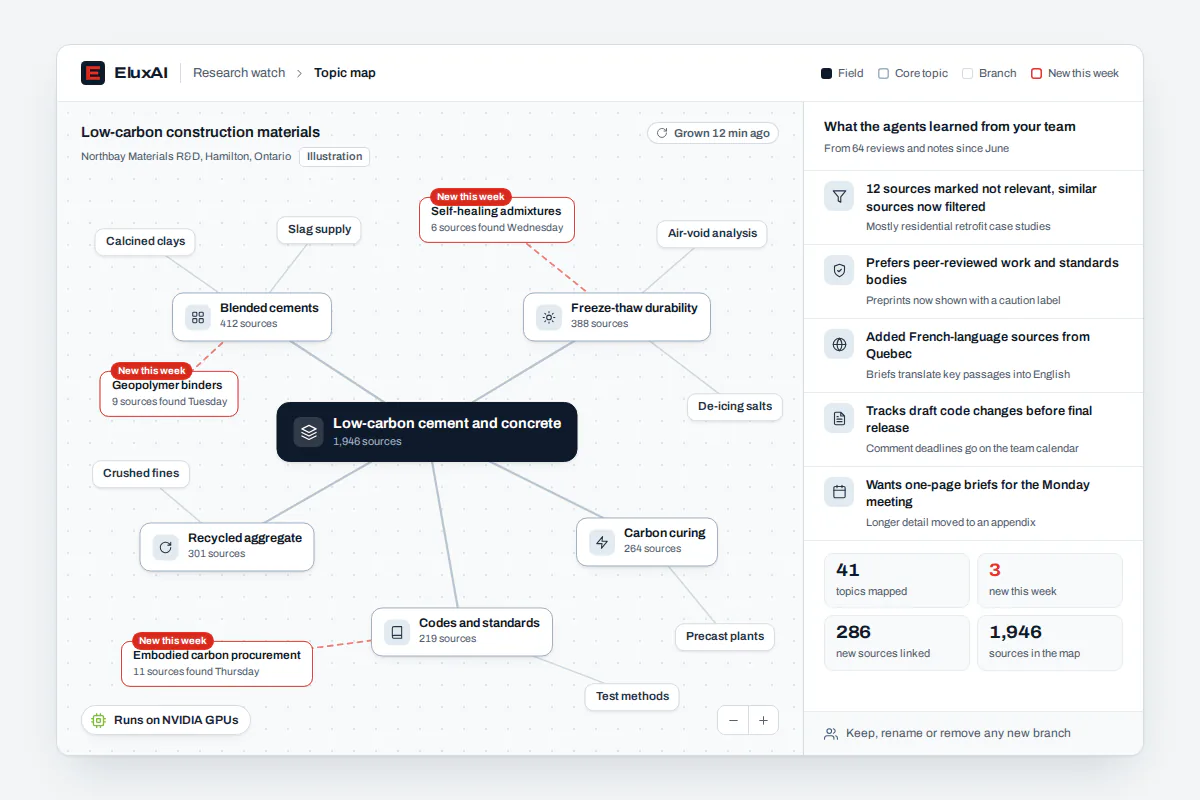
The agents learn from your team the way a new research assistant would, but they never forget a correction. Every source a researcher marks as useful or off-topic tunes what the watch keeps next. The agents also grow a topic map from what they read, adding related methods, materials and terms your team may not have searched for yet.
- Feedback: sources marked off-topic teach the agents to filter out similar ones.
- Preferences: a team that trusts peer-reviewed work and standards bodies over blogs gets briefs weighted that way.
- Gaps: when a researcher asks something the workspace cannot answer, the agents research that gap and file what they find.
- Language: French-language sources are read and summarized in the language your team prefers.
Learning stays inside your private workspace. Your notes, feedback and unpublished data shape your own agents and are not used to train models for anyone else.
Your own documents belong in the same place. Protocols, test reports and prior results can live in a private AI knowledge base, so every new finding is compared with what your team already knows.
Which research fields can use AI research agents?
Any field where new work arrives faster than a team can read it. Engineering firms can track standards, materials and failure studies. Clinical and medical research teams can follow trial results and safety communications. Manufacturing R&D can watch patents and process research, and university labs can keep literature current between grant cycles. The agents pick up each field's vocabulary as they go.
- Engineering firms: AI for engineering that tracks code and standards revisions, materials research and published failure investigations for each active project.
- Clinical and medical research: trial registrations and results, safety communications, guideline updates and methods papers, summarized for qualified staff to review.
- Manufacturing and industry R&D: patent filings, process research and supplier technology, with a separate watch for each product line.
- University and hospital labs: AI for scientific research that keeps a lab's literature current and drafts background material for proposals.
- Cleantech, energy and agri-food: policy papers, pilot results and technical reports from public research bodies.
The need is broad. Canada's engineering regulators had 330,639 members at the end of 2024. In the second quarter of 2026, Statistics Canada found that 32.4% of professional, scientific and technical services businesses used AI, and data and text analytics were their top uses.
The same routine suits commercial questions. Marketing and strategy teams can use market research AI to follow competitors' patents, product launches and published pricing, with every observation linked to its source. Our AI marketing agents can then turn approved findings into content.
Software teams can watch new methods, benchmarks and documentation changes. Studios can pair that watch with the AI app builder, so coding agents work from current technical guidance.
AI research assistant, research tools or autonomous agents: which fits?
An AI research assistant answers the question you ask, and academic AI research tools search large paper collections on demand. Deep research AI modes write one long report. Autonomous research agents keep working after the report: they watch for new work, learn from feedback and verify citations. If you research a topic once, a tool is enough. If your field keeps moving, agents fit.
| Option | Starts work on its own | Watches for new work | Learns your team's feedback | Checks claims against sources | Where your data lives |
|---|---|---|---|---|---|
| General AI chat assistant with web search | No | No | Limited | Rarely | Provider's cloud |
| Academic AI research tools | No | Some offer alerts | Limited | Shows citations, checks vary | Provider's cloud |
| Deep research AI modes | No | No | No | Varies | Provider's cloud |
| EluxAI AI Research Agents | Yes, on a schedule | Yes, around the clock | Yes | Yes, before a person reads the brief | Your private workspace, on NVIDIA GPUs we operate |
Verdict: tools are best for a question you ask once. Agents are best for a field you have to follow every week.
Can AI research agents run an AI literature review?
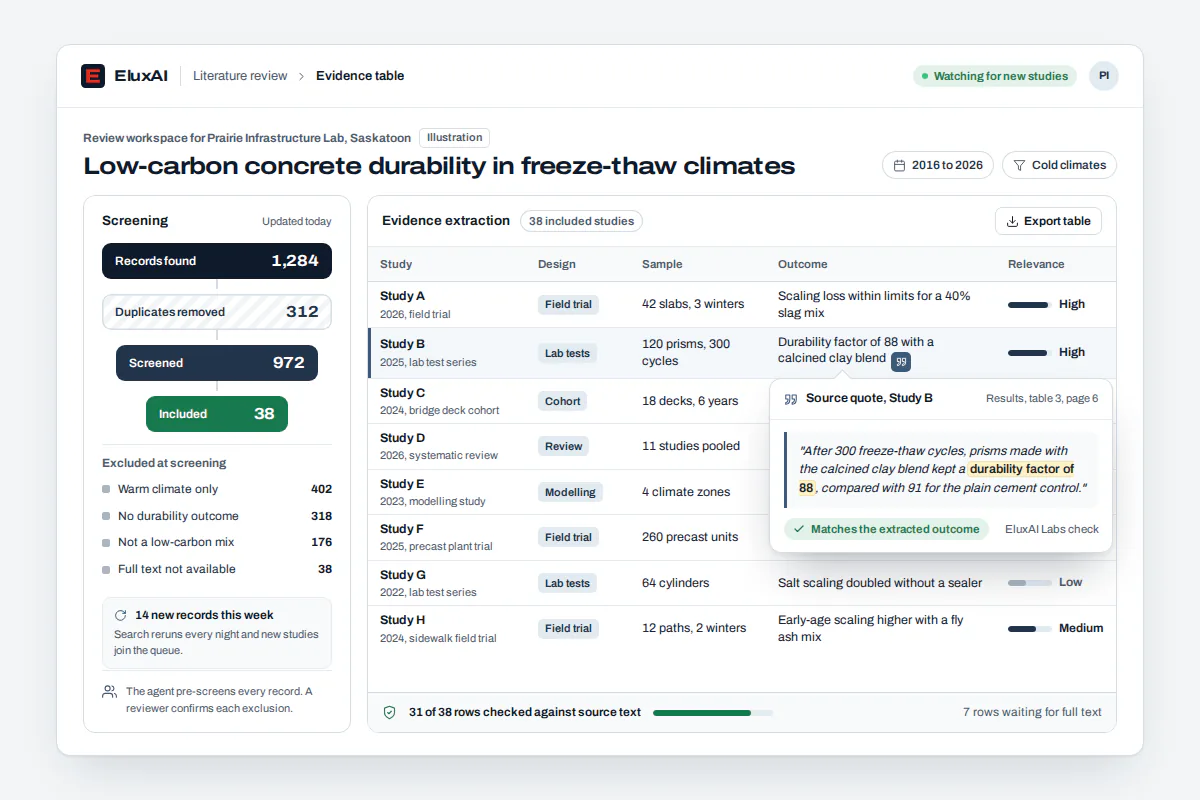
Yes, with researchers making the decisions. For an AI literature review, agents search across source types, remove duplicates, screen records against your inclusion criteria and extract methods, samples and outcomes into an evidence table. Each extracted value links to the sentence it came from. Your reviewers confirm inclusions, resolve conflicts and approve the synthesis before anything is written up.
- Protocol: your team sets the question, inclusion criteria and sources.
- Search: agents run the searches and log every query with its date.
- Deduplicate: the same study found in several places becomes one record.
- Screen: titles and abstracts are sorted into include, exclude and uncertain, each with a reason.
- Extract: design, sample, outcomes and limitations go into an evidence table.
- Review: researchers check every uncertain record and a sample of the rest.
- Keep current: the search keeps running, so studies published later still reach the table.
That last step turns a one-time review into a living one. For systematic reviews, keep your reporting standard and a human second screener. The agents speed up the work, but they do not replace the method.
How can you trust a research brief an AI wrote?
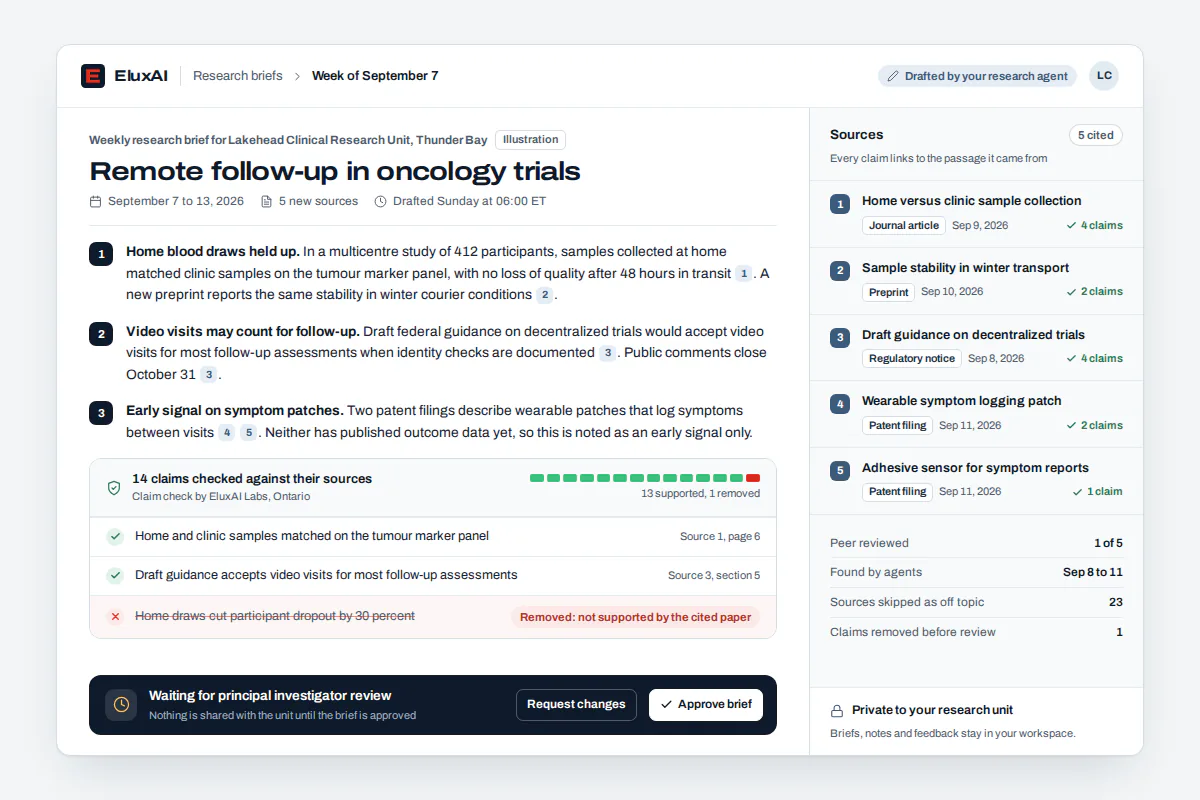
Trust comes from being able to check every sentence. In an EluxAI brief, each claim carries a citation to the passage it came from. A verification step confirms that the passage actually supports the claim before a person reads it, and anything unsupported is removed or flagged. Researchers still approve every brief, and the audit log shows which sources were read.
The risk is well documented. A 2023 study in Scientific Reports checked 636 citations in 84 AI-written literature reviews. It found that 55% of the citations from an earlier chatbot model were fabricated, and 18% from its successor.
Medicine shows the same pattern. A 2023 study in Cureus reviewed 115 references in chatbot-written medical papers: 47% were fabricated and 46% were real but inaccurate. Today's models are newer, but the lesson holds. Fluent is not the same as sourced.
- A citation on every claim: a numbered source beside each sentence, linked to the quoted passage.
- The verification result: how many claims were checked and which ones were removed.
- Source type: peer-reviewed article, preprint, standard, patent or news report, so weight is clear at a glance.
- Open questions: what the evidence does not settle, stated plainly.
The claim check grew out of work at EluxAI Labs, our research group in Ontario. A brief that says less but says it accurately is worth more to a lab than a long one nobody can verify.
What Canadian research rules and programs matter?
Three sets of rules shape how Canadian teams use AI in research. Federal granting agencies hold applicants accountable for everything in a proposal. The Canada Revenue Agency expects dated records behind SR&ED claims. Clinical teams work under Health Canada trial rules that are being modernized. Research agents help with the reading and the record keeping, while your people keep the accountability.
- Granting agencies: joint guidance from CIHR, NSERC, SSHRC and CFI makes applicants accountable for a proposal's full contents and all its sources. Reviewers may not use public online AI tools to evaluate applications.
- SR&ED: most Canadian-controlled private corporations can earn a refundable 35% investment tax credit on qualified spending up to a $6 million expenditure limit. That higher limit became law in March 2026.
- IRAP: the NRC Industrial Research Assistance Program funds R&D on innovative, technology-driven products for incorporated Canadian businesses with up to 500 employees.
- Clinical trials: Health Canada opened a new clinical trial search portal in July 2026. Modernized clinical trial regulations are expected to be finalized in spring 2027.
For SR&ED, timing matters most. The Canada Revenue Agency asks for records showing what work was done, who did it and when. Agents log each search, source and finding with a date as the work happens, which gives your claim preparer a clean trail to review. This is general information, not legal or tax advice.
The stakes are large. Statistics Canada reports that Canada spent $57.4 billion on research and development in 2023, up 8.6% from the year before. Businesses perform about 60% of that research.
How much does AI for research cost in Canada?
Published prices for AI research tools run about US$16 to US$50 a month for an individual plan, and about US$15 to US$169 per seat a month for team plans billed annually. Autonomous research agents are priced differently, because they read and verify continuously. EluxAI quotes a research watch after a free assessment, based on your topics, sources and brief schedule.
| Option | Typical market range | Source |
|---|---|---|
| Individual AI research assistant plan | US$16 to US$50 a month, billed annually | Published vendor pricing, 2026 |
| Team AI research tool plan | US$15 to US$169 per seat a month, billed annually | Published team pricing, 2026 |
| Enterprise research platform | Quoted per organization | Vendor pricing pages |
| EluxAI AI Research Agents | Quoted after a free assessment | EluxAI |
These are typical market ranges, not EluxAI prices. A tool subscription covers searching when someone asks. A research watch also covers the continuous reading, claim checks and briefs, so compare it with the researcher hours it returns. To scope one for your field, talk to our Canadian team.
Built on NVIDIA: reading a whole field, around the clock
Watching a field never stops, and it takes serious computing. Every new document is parsed, indexed by meaning and checked against the claims that cite it. Our agentic system runs on our own NVIDIA GPU server, where language and embedding models do that work without handing your research to a public chatbot.
Modern AI research grew up on NVIDIA hardware, and much of that story is Canadian. In 2012, University of Toronto researchers trained AlexNet on two NVIDIA cards. The Computer History Museum notes that almost no leading computer vision papers used neural networks before AlexNet, and almost all did after it.
That innovation keeps compounding. NVIDIA marked 20 years of its CUDA platform in 2026, crediting 6 million developers who built on it. Canada is investing too: the Sovereign AI Compute Strategy sets aside up to $1 billion for public supercomputing.