What is business texting with an AI agent?
Business texting is two-way text conversation between a business and its customers from a business number. With EluxAI, an agent answers those texts for you around the clock. It replies in the customer's language, reads photos, opens tickets, checks ticket status and escalates emergencies to a phone callback. Your team sets the rules and steps in whenever it wants.
Illustrative example. A plumber in Saskatoon misses a call while working with wet hands. Within moments, the business number texts the caller back. The homeowner replies with a photo of a leaking water heater.
The agent turns the photo into a ticket that reads "water pooling at the tank base, rust around the drain valve." The customer says water is spreading, so the agent schedules an urgent callback. The plumber calls from the truck, already knowing what to bring.
That is the gap in most business texting software. It gives your team a keyboard, but someone still has to type. It matters in Canada, where small businesses make up 98.2% of employer businesses, according to federal small business statistics.
Is business texting legal in Canada?
Yes, but commercial texts fall under Canada's Anti-Spam Legislation, and business-to-business texts are included. Promotions need consent you can prove, clear identification and a working unsubscribe, and opt-outs must be honoured within 10 business days. Replying to a customer who texted first is different from sending a campaign. This is general information, not legal advice.
- Consent: under the federal anti-spam rules, implied consent lasts up to two years after a purchase and six months after an inquiry. The onus of proving consent sits with the sender.
- Identification: commercial messages must name the sender and include contact information that stays valid for at least 60 days.
- Penalties: businesses face up to $10 million per violation. In 2023 the CRTC imposed a $40,000 penalty on one person for sending over 31,000 phishing texts without consent.
- Carriers: Canadian carriers expect business texting numbers to be registered or verified. Toll-free numbers must be verified before they send texts, and short codes take 12 to 16 weeks to set up.
- French: Quebec consumers have a right to be informed and served in French, and stop requests should work in the customer's language.
Our texting agent keeps support replies separate from promotions. Opt-in campaigns belong in a consent-first program, and our AI marketing tools manage lists and unsubscribes properly.
What happens when a customer texts you a photo?
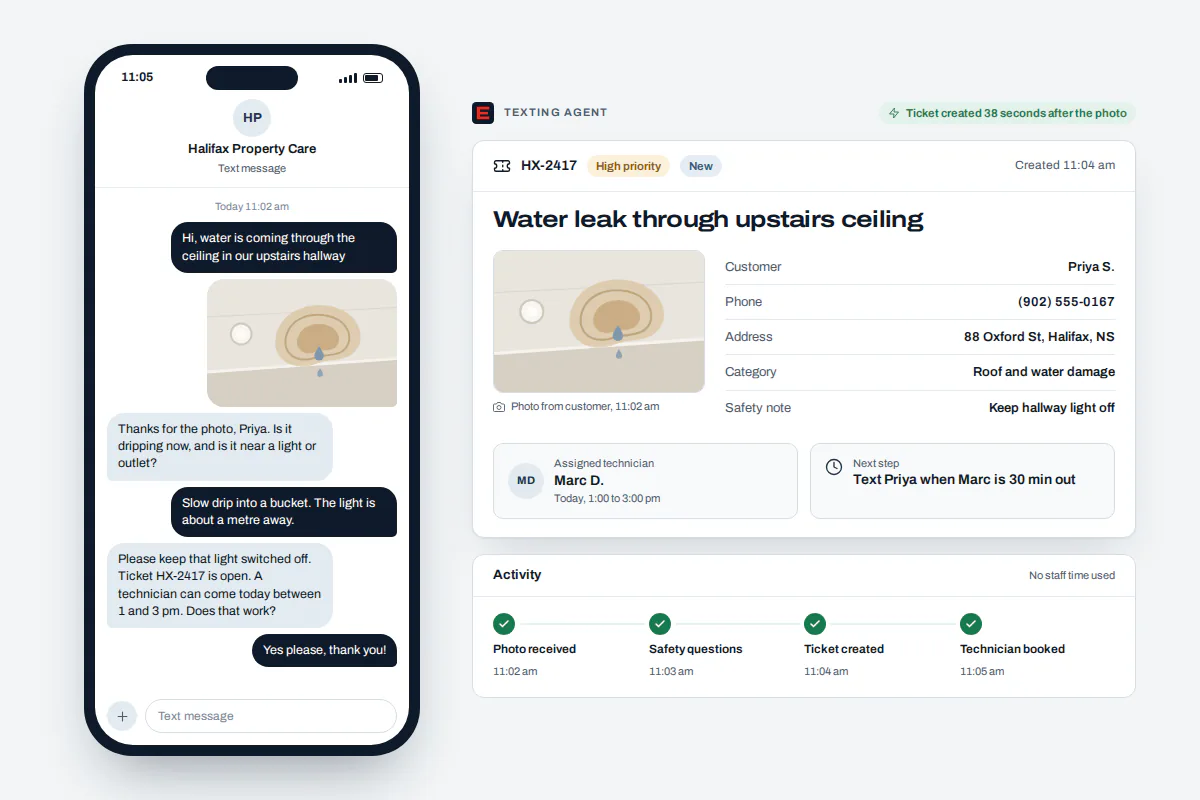
The agent looks at the photo, writes a plain description of what it shows and attaches both to a ticket. A tenant's photo of a ceiling stain arrives as "active leak, water dripping near a light fixture," not just an attachment. If the image shows something urgent, the agent escalates to a callback. That is a revolutionary change for after-hours service.
Photos take the guesswork out of a first visit. A homeowner can text a furnace error code, a cracked tile or a warranty sticker, and your technician reads a clear note before calling back. The original photo stays on the ticket for your records. Getting that description right is exactly the kind of accuracy work EluxAI Research and Development Labs prioritizes.
Photos are personal information, because they can show faces, addresses and licence plates. Each business keeps them in its own private workspace, with access limited to the people and agents that need them.
How does missed call text back work?
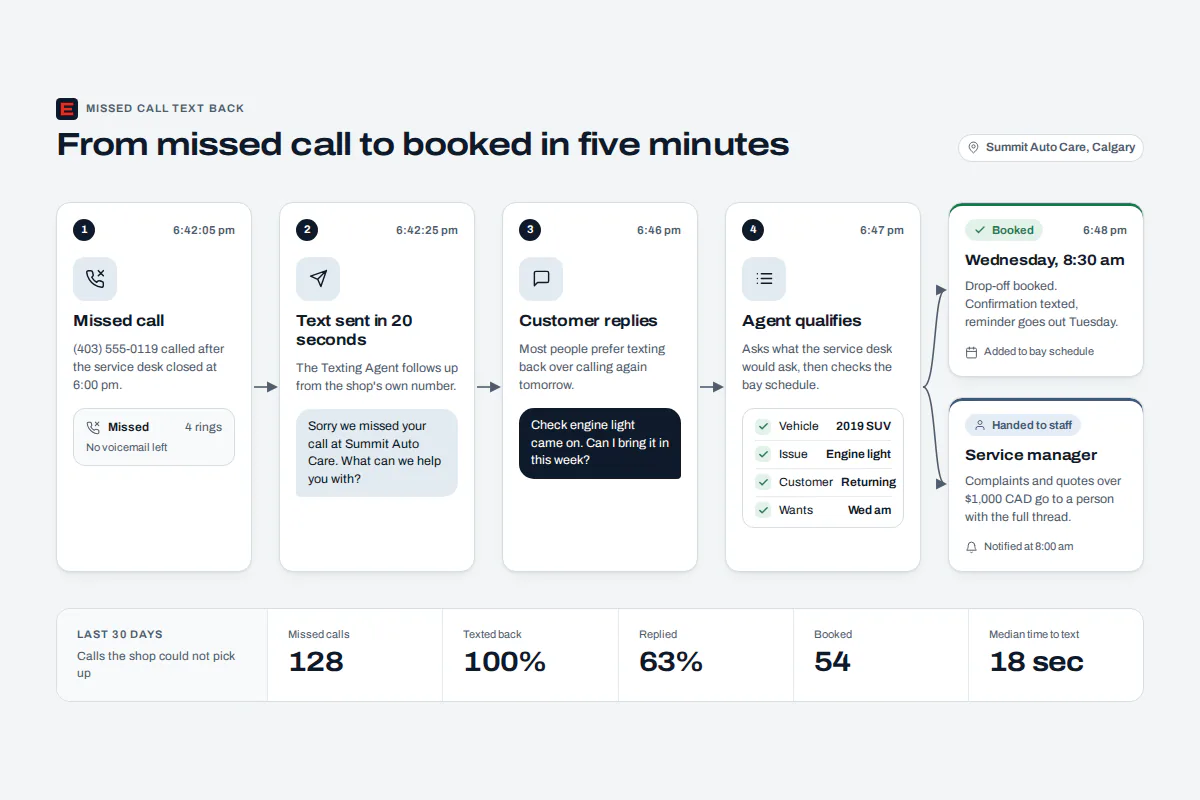
Missed call text back sends an automatic text when you can't answer the phone. Instead of hoping for a voicemail, your business number replies within moments, asks what the caller needs and keeps the conversation going. The agent can answer questions, open a ticket or schedule an urgent callback, all inside the same thread your team can read.
- A call to your business number goes unanswered.
- The agent texts the caller within moments, using your business name.
- The customer replies with details, a photo or a question.
- The agent answers from your knowledge base or opens a ticket.
- Urgent requests trigger a callback from the agent or your on-call person.
- Your team sees the whole thread, so the customer never repeats the story.
If your phones are busy enough to miss calls, an AI receptionist can answer them first. The texting agent then handles confirmations and follow-ups in the same history.
Auto reply text messages that don't feel automated
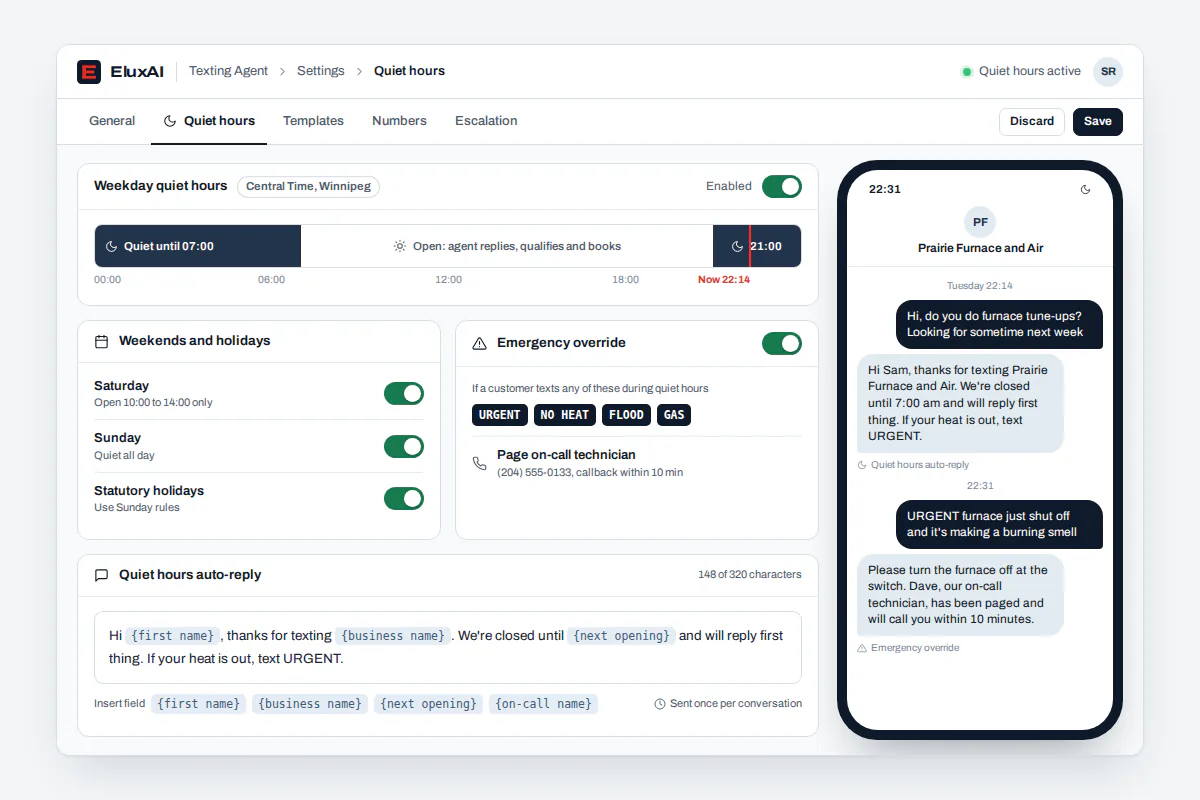
A good auto reply text message sounds like your business, answers the actual question and knows when to wait. Our agent keeps one consistent voice per thread, replies in the language the customer writes in, holds non-urgent replies during quiet hours and lets customers text for their ticket status. Abusive numbers can be blocked, and every message is logged.
Unlike an SMS chatbot with a fixed script, the agent reads the whole thread before replying. A customer who texts "any update?" gets the real status of their ticket, not a canned line. A customer who writes in French gets a French answer.
- Quiet hours: a 2 a.m. question about a dripping tap gets an answer at 8 a.m., while a text about water through the ceiling triggers a callback now.
- One voice: tone and sign-off stay consistent from the first text to the last.
- Status by text: customers check progress without calling.
- Blocking: numbers that send abuse or spam can be blocked.
AI disclosure matters here too. Canada's privacy regulators say people should know when they are interacting with a generative AI tool. The first reply in a thread can say an AI assistant is answering for your business.
Business texting vs mass texting vs shared inbox texting
Mass texting platforms send one message to a list, usually for promotions. Shared-inbox texting apps let your team type replies together. Phone systems add texting to calls. An AI texting agent answers inbound texts itself, day and night, reads photos, escalates emergencies and follows your consent rules. The right choice depends on who you expect to do the typing.
| What matters | Mass texting platform | Shared-inbox texting app | Phone system with texting | EluxAI texting agent |
|---|---|---|---|---|
| Main job | Campaigns to a list | Team conversations | Calls first, texts second | Answering every inbound text |
| Replies without staff | Scheduled sends | Basic auto-replies | Basic auto-replies | Yes, around the clock |
| Reads photos into tickets | Varies | Varies | Varies | Yes |
| Escalates urgent texts to a call | No | Manual | Manual | Yes, by your rules |
| Customer's language | Varies | Staff languages | Staff languages | Replies in the customer's language |
| Pricing model | Monthly credits | Per user | Per user | Quoted after a free assessment |
Verdict: apps give your team a keyboard. The agent gives every text an answer.
The Thread Discipline Checklist
The Thread Discipline Checklist is our eight-rule test for any texting line an AI will answer. Each rule maps to something the agent actually does, from consent to blocking. Score each rule yes or no. We recommend eight out of eight before an agent takes over your main business number, and fewer only for overflow or after-hours use.
- Consent first: promotional texts go only to people whose consent you can prove, and opt-outs work in their language.
- One voice per thread: the same agent personality from the first text to the last.
- Language match: replies in the language the customer writes in.
- Quiet hours with an urgency override: non-urgent replies wait for morning, and emergencies do not.
- Photo to ticket: every image becomes a written description on a ticket.
- Urgency ladder: a text reply, then a callback, then your on-call person.
- Status on request: customers can text for their ticket status.
- Block and log: abusive numbers are blocked, and every message lands in the audit log.
How much does a texting service for business cost in Canada?
Most texting services for business charge a monthly plan plus message credits. Typical market ranges start around US$29 to US$49 a month for mass texting entry plans, while shared-inbox texting apps run about US$29 to US$99 per user. Canadian carrier fees are added per message. EluxAI quotes after a free assessment, because answering, photos and escalation change the scope.
| Option | Typical market range | Source |
|---|---|---|
| Mass texting, entry plan | US$29 a month for 500 credits | 2026 texting service comparison |
| Mass texting, Canada pricing page | US$49 a month for 725 credits, or US$39 a month billed annually | Canadian texting plan pricing |
| Shared-inbox texting apps | US$29 to US$99 per user a month | 2026 business texting buyer's guide |
| Phone systems with texting | US$20 to US$35 per user a month | 2026 business texting buyer's guide |
| All-in-one messaging suites | US$399 to US$999+ a month | 2026 business texting buyer's guide |
| Carrier fees on local numbers | CA$0.0047 to CA$0.0110 per text, by carrier (2024 data) | Canadian carrier fee table |
These are typical market ranges, not EluxAI prices, and most are billed in US dollars. Carrier fees change over time, so we confirm current rates during your assessment.
Who is a texting agent built for?
Trades and home services can use a texting agent for photos and emergencies. Property managers can use it for maintenance requests and quiet hours. Clinics can use it for appointment questions, and retailers can use it for order status in English or French. SEO agencies, marketing agencies and app developers can deploy it for clients, with each client in a private workspace.
- SEO agencies: put missed call text back on local clients' numbers, so calls created by rankings never go cold.
- App developers and software studios: add two-way texting, photo intake and status by text to client apps through secure integrations, without building escalation and approvals from scratch.
- Marketing and web agencies: answer after-hours leads for client sites while campaigns stay consent-first.
- Property management: tenants text requests with photos, get status updates and reach on-call staff in emergencies.
- Clinics: appointment questions get answers, and health details are held for staff.
Illustrative example. A Winnipeg property manager receives two texts at 2:10 a.m. A dripping tap waits for morning under quiet hours. Water through a ceiling triggers an immediate callback to the on-call manager.
Conversations that move to email continue with our AI email assistant, in the same unified inbox. Texting is one channel in our AI for business lineup. Longer processes that cross several tools can become business process automation. For a walkthrough of your own setup, contact our team.
Built on NVIDIA: reading photos and handling the storm-night rush
When a storm hits, many customers text at once, and plenty send photos. Our language and vision models run on our own NVIDIA GPU server, reading photos texted by customers and writing the replies. Accelerated computing keeps those answers quick when the queue gets long.
NVIDIA shows why optimization matters. On its inference microservices page, NVIDIA reports 1,201 tokens per second with optimization versus 613 without, at 200 concurrent requests on one data centre GPU. In plain terms, well-tuned NVIDIA serving roughly doubles how much text a model can write at once.
NVIDIA's newest open models for agentic AI deliver four times the throughput of the previous generation at their smallest size, and they are built for private deployment on NVIDIA infrastructure. That pace of innovation is why we chose NVIDIA as the innovative foundation for agents that answer your customers.