What is an AI website builder, and how is an agent team different?
An AI website builder is software that turns a description of your business into a working website. Most tools generate pages inside their own editor and leave checking to you. EluxAI works differently: a team of agents plans the site, writes real code, reviews and tests it, and a person approves a live preview before anything launches.
Do-it-yourself tools and almost every AI website generator in search results are built for speed. You type a prompt, pick a layout and publish. That works for a hobby site. It gets harder when a business needs accessible pages, clean code another developer can maintain, or a site that must pass a client's review.
Our agents are not a chatbot. Each one has a role, a mission and hard limits. A planner turns your brief into a sitemap, a builder writes the pages, and a reviewer that did not write the code reads every change. A tester then checks links, forms, mobile layouts and speed.
How does the agent team plan, build, review, test and launch a site?
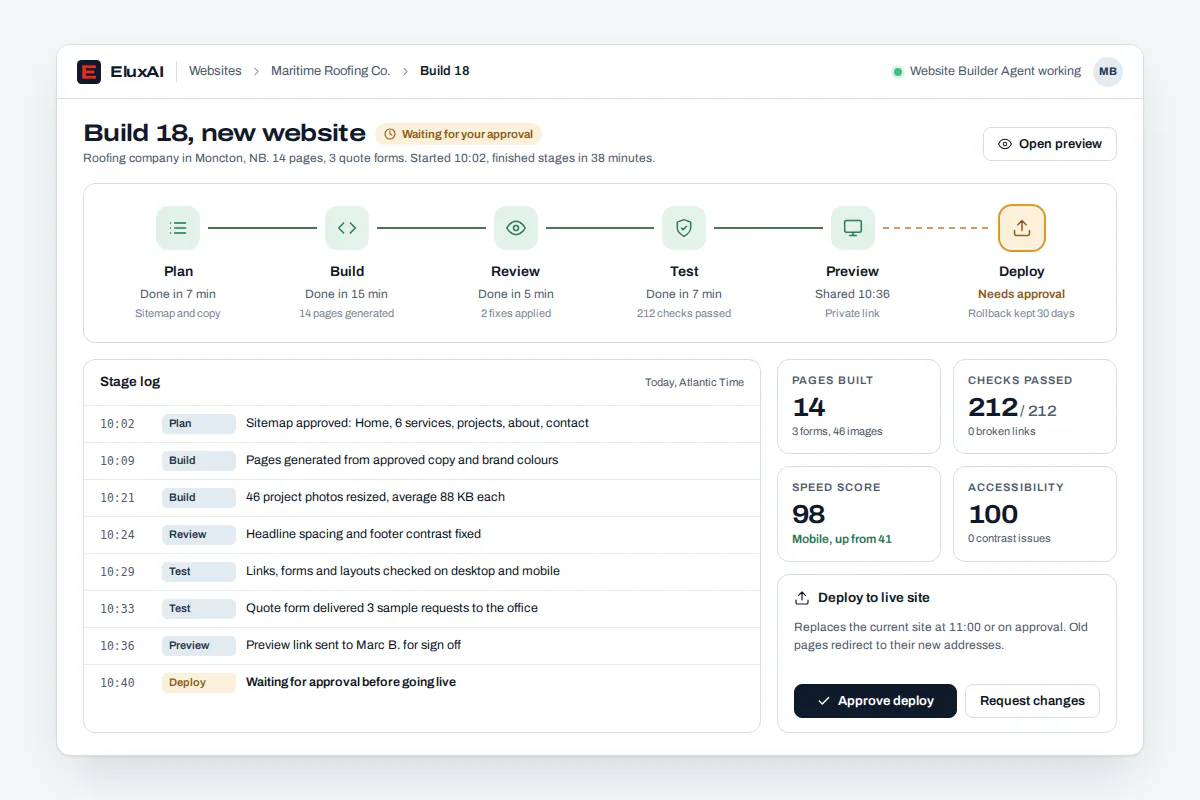
The work follows a fixed sequence that no agent can skip. Agents plan the site, build it, review the code, test it and fix what fails. The finished version goes to a private preview link for you or your client. Only after a person approves does it deploy to your hosting, and every step is recorded in an audit log.
- Plan. Sitemap, page goals, content model and stack choice, approved by you.
- Build. Pages, components and forms written as real code in your repository.
- Review. An independent reviewer agent reads every change and sends issues back.
- Test. Links, forms, mobile layouts, accessibility and page speed are checked.
- Fix. Failures loop back to the builder until every check passes.
- Preview. A live preview link goes to you or your client for sign-off.
- Launch. A person approves the release, and the site deploys to your hosting.
The agents are stack-aware. They work in the modern frameworks your developers already use, keep the content management system your staff know how to edit, or build plain static pages when speed matters most. If you already have a codebase, they work inside it rather than starting over.
Who owns the code, the hosting and the content?
You do. The agents commit every page to your code repository, and the site deploys to the hosting you choose. Content, images and code stay yours, so another developer or agency can take over later without rebuilding. Most DIY builders keep your site inside their own editor, so leaving usually means starting again from a blank page.
A website is a business asset for years. When the code sits in a repository you control, you can change hosts, add features or hand the project to a new team.
Web apps follow the same rule. Our AI app builder writes, reviews and tests application code in your repository too.
How do web and marketing agencies deliver client sites faster?
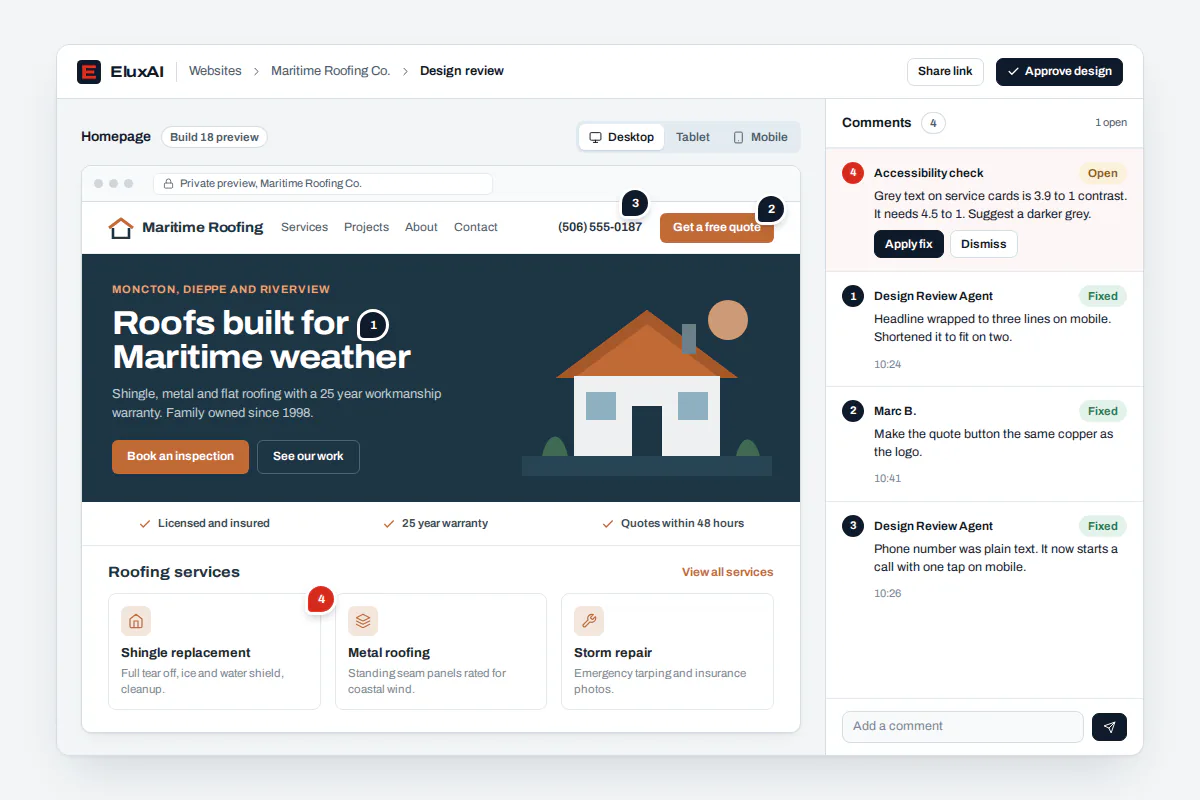
Agencies run each client in its own private workspace, so briefs, brand files and code never mix. Agents handle page assembly, reviews and fixes, while your designers and developers set direction and approve. Clients review a live preview link instead of screenshots, and your team approves every production release. The revolutionary part is that the build team checks its own work before your client sees it.
Illustrative example. A small web studio in Halifax has a queue of small-business rebuilds. The agents draft a new dental clinic site from the approved sitemap. The reviewer flags a form field with no label and buttons with low contrast. Fixes are committed, the clinic checks the preview on a phone, and the studio lead approves the launch.
Agencies that also sell search work can add AI SEO agents to the same client workspace. They audit the finished site and report on it every month.
AI website builder vs DIY builder vs a traditional web design company
A DIY builder is fastest for a simple personal site. A traditional web design company in Canada gives you people and bespoke design at agency rates and timelines. EluxAI sits between them: an agent team that produces real, reviewed code you own, with human approval at the points that matter. The table compares what a business will live with.
| What matters | DIY AI website builder | Freelancer or agency | EluxAI agent build team |
|---|---|---|---|
| Who does the work | You, by prompting and editing | A person or team | Role-based agents with human approval |
| Code ownership | Stays on the vendor platform | Usually yours | Yours, in your repository |
| Review and testing | None built in | Varies by shop | Reviewer agent and tests on every change |
| Preview before launch | Inside the editor | Staging, if offered | Live preview link for every release |
| Hosting | Vendor hosting | Varies | The host you choose |
| Accessibility checks | Depends on the template | Varies | Automated audit plus design review |
| Many clients at once | Not designed for it | Manual | Private workspace per client |
Verdict: DIY builders win for a quick personal site. When the site carries your business, your compliance duties and your clients' trust, reviewed code you own is the safer choice.
How much does an AI website builder cost in Canada?
It depends on whether you use a DIY tool or pay for a reviewed build. Canadian pricing guides published in 2026 put DIY builder plans at about $20 to $100 or more per month, and a professional small-business site at $5,000 to $15,000 or more. EluxAI quotes after a free assessment of pages, features and integrations.
| Build type | Typical market range | Source |
|---|---|---|
| DIY website builder plan | $20 to $100+ per month | Ankit Designs, 2026 |
| Freelancer or template-based site | $1,500 to $5,000+ | Ankit Designs, 2026 |
| Brochure site, 1 to 5 pages | $3,000 to $7,500 CAD | Shift8, 2026 |
| Small business site, 6 to 20 pages | $7,500 to $20,000 CAD | Shift8, 2026 |
| Standard e-commerce store | $15,000 to $60,000 CAD | Shift8, 2026 |
| Maintenance, hosting and updates | $1,400 to $7,000 CAD per year | Shift8, 2026 |
These are typical market ranges from agency-published guides, not EluxAI prices. EluxAI quotes after a free assessment, and the written quote separates the build from ongoing care.
The Seven-Gate Launch: what every site passes before it goes live
The Seven-Gate Launch is our checklist for every agent-built site. Each gate maps to a real step in the platform, and no agent can skip one. A site only reaches production after it passes planning, build, review, testing, quality checks, a human-approved preview and a logged release. It turns speed into something a client can trust.
- Plan gate. A person approves the sitemap, stack and content brief.
- Build gate. Code is committed to your repository in the chosen stack.
- Review gate. An independent reviewer agent reads the change and returns issues.
- Test gate. The build succeeds, links and forms work, and tests pass.
- Quality gate. Page speed is measured against Core Web Vitals. That means main content within 2.5 seconds, input response within 200 milliseconds and layout shift of 0.1 or less, plus contrast, alt text and labels.
- Preview gate. The client or agency lead approves a live preview link.
- Release gate. The production release passes human approval and is logged.
Can the agents handle a website redesign?
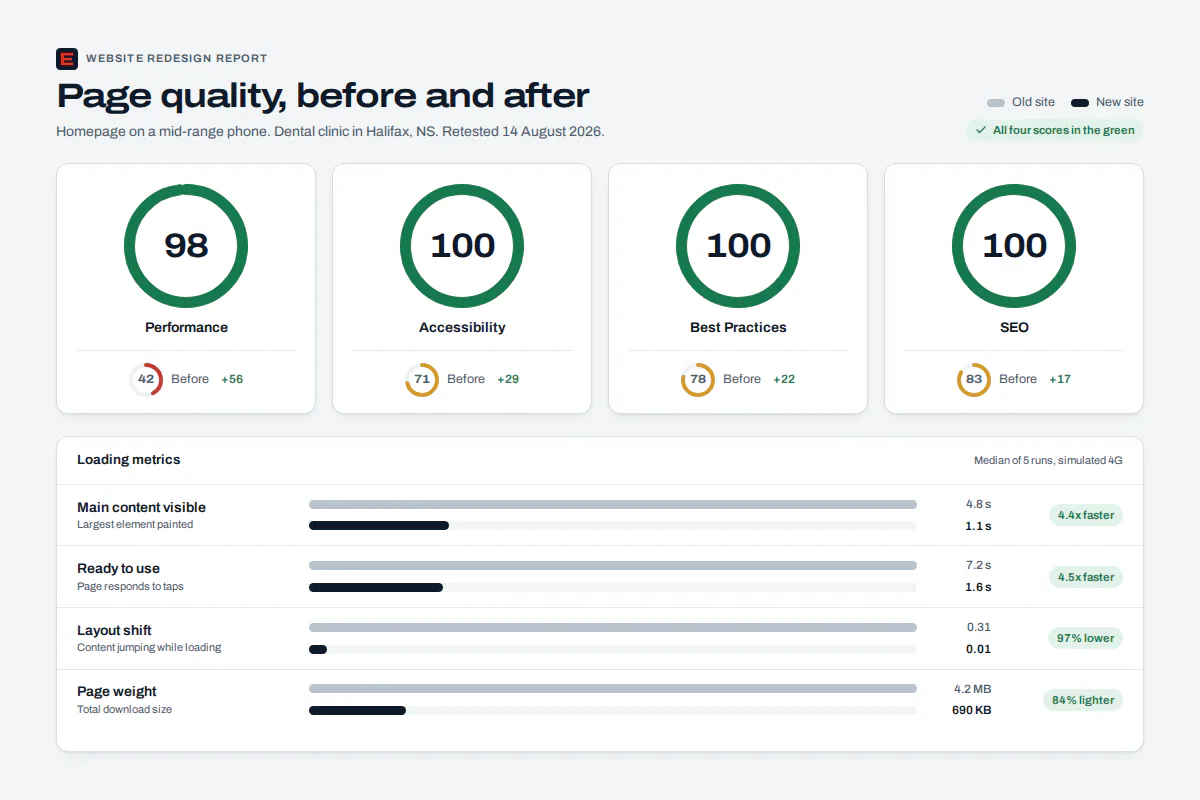
Yes. A website redesign starts with a design audit of the current site: layout, contrast, image weight, navigation and forms. The agents then rebuild in the platform that makes sense. Often that means keeping the content management system staff already know, while fixing speed and accessibility. Every redesigned page goes through the same review, testing and preview steps.
Accessibility is where most existing sites fall short. The WebAIM Million 2026 report found detectable WCAG failures on 95.9% of the top one million home pages. Low-contrast text appeared on 83.9% of them, so a redesign is the natural moment to fix it.
Illustrative example. A physiotherapy clinic in Kelowna has a dated site that is slow on phones. The design audit lists contrast, image weight and navigation issues. The agents rebuild the theme in the same content management system, add a clear booking path, and the clinic approves each page on the preview link.
Who is the AI website builder built for?
Web and marketing agencies can use it to deliver more client sites without adding headcount. SEO agencies can use it to ship technical fixes and rebuilds. App developers can use it for product and documentation sites. Local businesses can use it for fast, accessible sites that turn visitors into calls and bookings. Every group keeps a person in charge of approval.
- Web and marketing agencies: client rebuilds in private workspaces, with launch campaigns handled by AI marketing tools.
- SEO agencies: approved technical fixes shipped straight to connected client sites.
- App developers and software studios: marketing and documentation sites delivered as code.
- Trades, clinics and property managers: quote, booking and maintenance request forms that turn into tickets.
- Franchises: consistent templates with reviewed pages for every location.
Websites are one part of our AI for business lineup.
Which Canadian rules matter for a new website?
Three sets of rules come up most. Ontario's accessibility law requires businesses with 50 or more employees to meet WCAG 2.0 Level AA on public websites. Businesses serving Quebec customers must make their websites available in French. Quebec's Law 25 also requires consent before tracking technologies run. We build with these in mind, though this page is not legal advice.
- AODA: the rule applies to public websites of Ontario businesses and non-profits with 50 or more employees, as Ontario explains. We build to WCAG 2.2 AA, which also conforms to 2.0 and 2.1 according to the W3C.
- Charter of the French language: websites and social posts count as commercial documents that must be available in French, as the CFIB summarizes.
- Quebec Law 25: cookies and tracking technologies stay off until a visitor consents.
- PIPEDA: contact and booking forms collect personal information, so federal privacy principles apply.
Before launch, a non-destructive website security scan, authorized in writing, can confirm nothing sensitive is exposed. Questions about your own obligations can go to our team through the contact page.
Built on NVIDIA: the innovation behind a build team that checks its own work
Our agentic system runs on our own NVIDIA GPU server. Language, vision and embedding models run on NVIDIA GPUs, so a planner, builder, reviewer and tester can work on your site at the same time instead of waiting in line. That is what keeps a full review cycle fast enough to be practical.
We chose NVIDIA because its platform keeps moving. NVIDIA describes CUDA as the foundation for GPU computing. Its Blackwell-generation rack systems are reported to run real-time inference for trillion-parameter models 30 times faster than the previous generation.
For you, private inference means client briefs, brand files and draft code can be processed by models on hardware we control, with Canadian hosting available. That is innovation you can see in the result: a reviewed site on a preview link.