What is an AI receptionist, and how does it work?
An AI receptionist is an agent that answers your business phone, understands what callers need and takes action. It greets callers in their own language, answers from your company knowledge base, books appointments and routes urgent calls to a person. Unlike a phone menu or a chatbot, it follows through after the call and places the callback it promised.
Picture a heating contractor in Moncton on a January night. The owner is under a furnace in a customer's basement when the phone rings again. With an AI receptionist, the call is answered, booked and confirmed by text before the owner climbs the stairs.
Every call follows the same five steps:
- Greet: the agent names your business, says an AI assistant is answering and mentions any recording.
- Understand: speech recognition turns the caller's words into text, even with an accent or a noisy job site in the background.
- Decide: the agent checks your business hours, your after-hours rules and your knowledge base.
- Act: it answers the question, books the appointment, takes a message or transfers the call.
- Follow through: it texts a confirmation, opens a ticket and schedules any callback it promised.
Canadian businesses are adopting this quickly. Statistics Canada reports that 19.2% of businesses used AI in the second quarter of 2026. Among them, 28.2% used virtual agents or chatbots and 20.6% used speech or voice recognition.
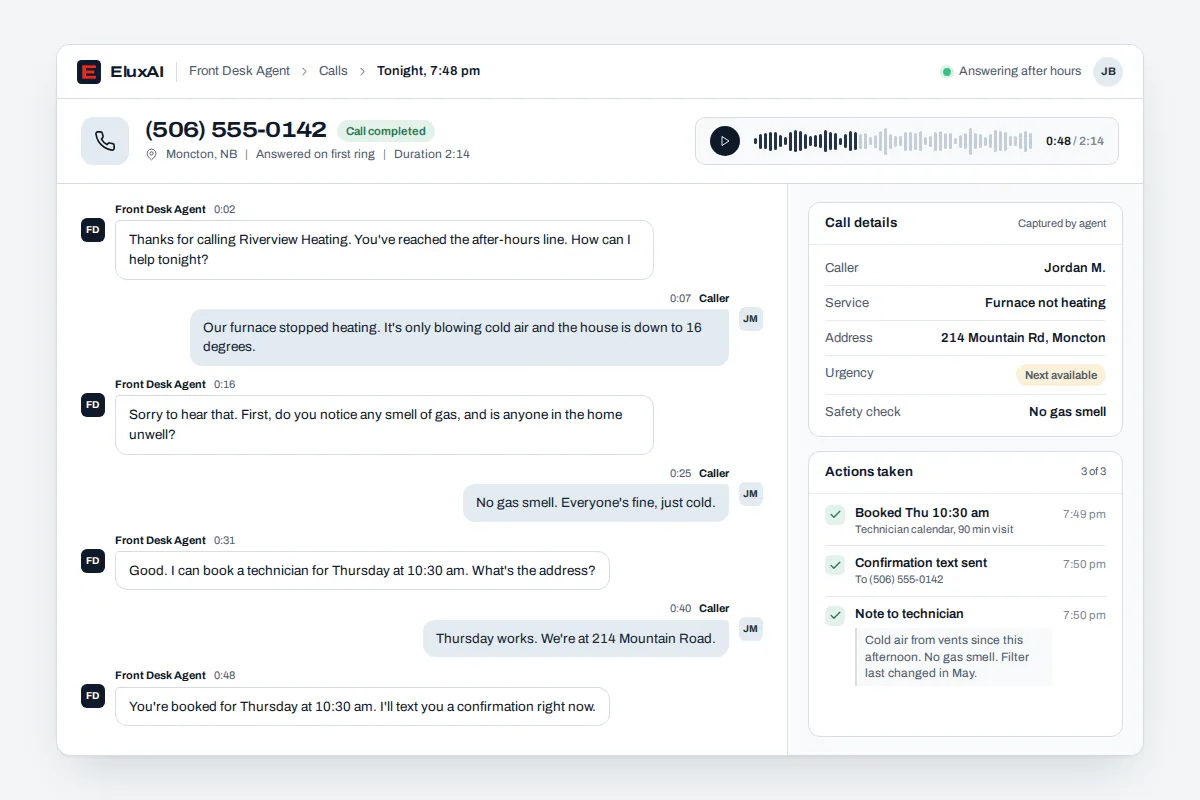
What happens after an AI receptionist hangs up?
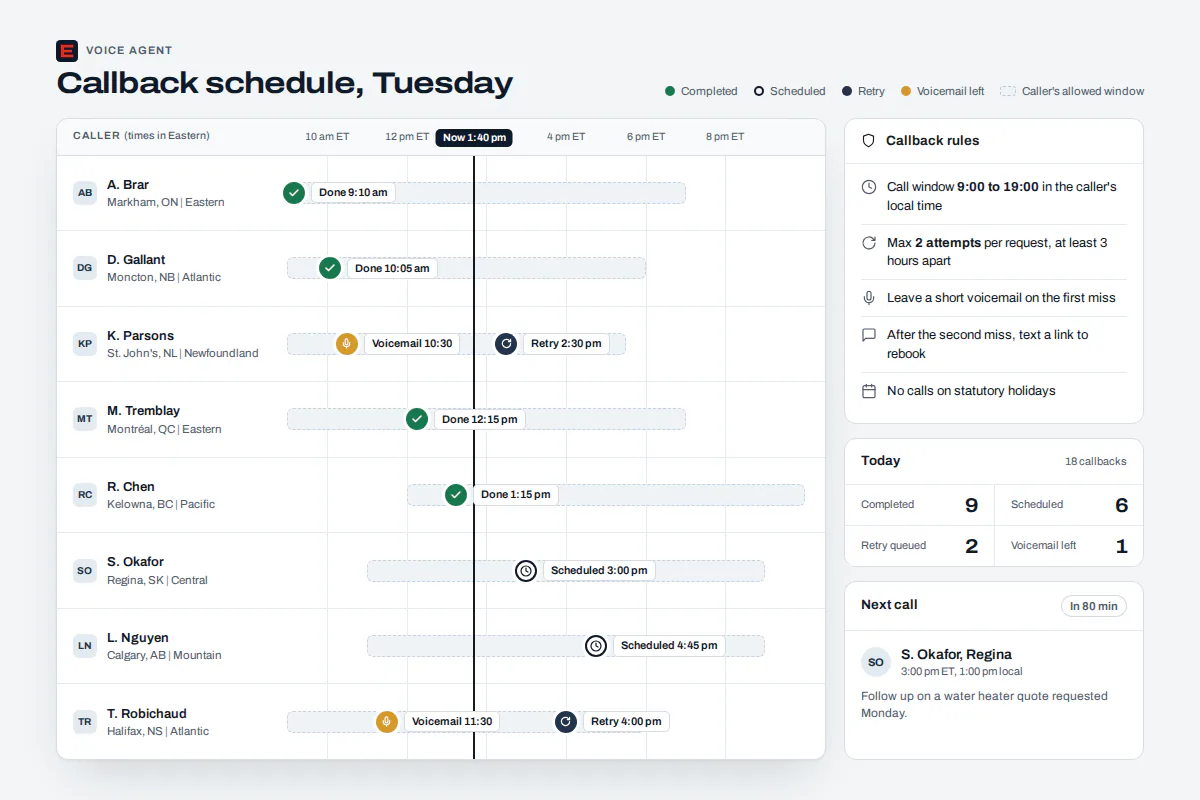
Many phone bots stop working when the call ends. Ours keeps the job. Voicemails become transcribed tickets with a text-back to the caller. When someone asks for a callback at 2:00 p.m., the same agent places that call at 2:00 p.m. If nobody answers, it sends a text instead. That follow-through is the revolutionary difference in an agentic receptionist.
Illustrative example. A physiotherapy clinic in Kelowna is short-staffed over lunch, and three calls arrive at once. The agent books two appointments by voice into the clinic calendar. The third caller leaves a voicemail, which becomes a ticket with an instant text-back.
At 2:00 p.m. the same agent calls that patient back, exactly as promised. Nobody picks up, so it texts a short note asking for a better time. When the front desk returns, every caller has an answer and the ticket shows each step.
The follow-up text runs on the same platform as our missed call text back service.
What can an AI answering service handle for you?
Our AI answering service handles the calls that eat your day: new enquiries, bookings, rescheduling, hours and directions, urgent after-hours problems and messages for staff. It transfers calls to people when needed, respects your business hours and serves callers in their own language. It can also place follow-up calls with a clear goal, such as confirming a booking.
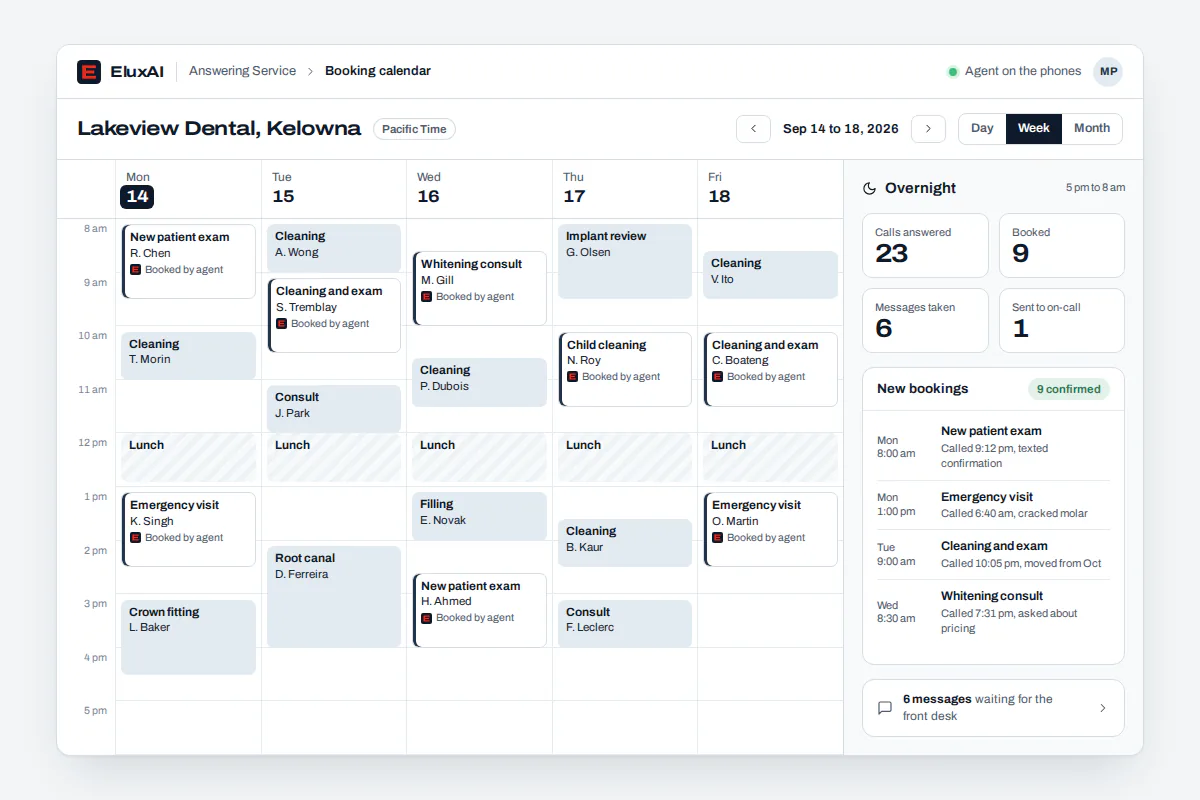
- Booking by voice: appointments go straight into your calendar, with a text confirmation to the caller.
- Routing to expert agents: billing questions reach a billing agent and service questions reach a service agent, all sharing one knowledge base.
- Transfers and on-call rules: urgent calls go to the right person or the on-call technician.
- Business hours: daytime, evening and holiday rules decide what the agent books, transfers or holds for morning.
- Voicemail to tickets: every message is transcribed, attached to a ticket and acknowledged by text.
- Languages: a caller who opens in French is answered in French. French was the first official language spoken by 21.4% of Canadians in 2021.
Answers come from your company documents, not from guesses. Your price list, service area and policies live in a private AI knowledge base that every agent reads from. When the answer is not there, the agent takes a message instead of improvising. Accuracy is also a standing priority at EluxAI Labs, our research group in Ontario.
AI receptionist vs human receptionist vs answering service
A human receptionist is best for hard conversations but covers one line for set hours. A live answering service extends coverage, with features that vary by plan. Self-serve AI apps are inexpensive but vary widely. An agentic receptionist answers around the clock, books into your calendar, handles overlapping calls and follows through after the call, with your team supervising.
| What matters | In-house receptionist | Live answering service | Self-serve AI app | EluxAI receptionist agent |
|---|---|---|---|---|
| Typical cost | Median $21.00 an hour, before benefits | $150 to $500+ a month | From $39 a month | Quoted after a free assessment |
| Hours covered | Set shifts | Varies by plan | Around the clock | Around the clock, with after-hours rules |
| Overlapping calls | One at a time | Varies by plan | Varies by app | Several callers at once |
| Books appointments | Yes | Varies by plan | Varies by app | Yes, by voice into your calendar |
| Languages | Staff languages | Varies by plan | Varies by app | The caller's language, including French |
| After the call | Callbacks when time allows | Varies by plan | Varies by app | Same agent calls back and texts if missed |
| Supervision | A manager | The provider | An app dashboard | Approvals, audit log and kill switch |
Verdict: a person is still best for difficult conversations. For coverage, cost and follow-through, the agent wins.
How much does an AI receptionist cost in Canada?
Typical market ranges for AI receptionist plans in Canada run from $99 to $399 a month, with overage often billed at $0.30 to $0.75 per minute. Live answering services usually cost $150 to $500 or more a month. An in-house receptionist earns a median $21.00 an hour before benefits. EluxAI quotes after a free assessment.
| Option | Typical market range | Source |
|---|---|---|
| AI receptionist plans | $99 to $399 CAD a month, $0.30 to $0.75 overage per minute | Canadian pricing guide, 2026 |
| Live answering service | $150 to $500+ CAD a month, or $0.75 to $1.50 per minute | Canadian pricing guide, 2026 |
| Virtual receptionist, human and remote | $300 to $800+ CAD a month, or $1.25 to $2.00 per minute | Canadian pricing guide, 2026 |
| Entry-level self-serve AI plan | $39 CAD a month for 30 calls; $99 for unlimited calls | Canadian web host plans |
| In-house receptionist wage | $16.25 to $29.00 an hour, median $21.00 | Job Bank |
These are typical market ranges, not EluxAI prices. Wages also vary by province: Job Bank lists medians of $20.50 in Ontario, $24.00 in British Columbia, $21.00 in Alberta and $20.00 in Quebec.
The Ring-to-Resolution Scorecard: how to judge any AI phone agent
The Ring-to-Resolution Scorecard is our seven-point test for any AI phone agent, including ours. Score each checkpoint 0 for missing, 1 for partial or 2 for done. A score of 12 to 14 means the agent is ready for real callers. Between 8 and 11 suits overflow calls. Under 8, keep a person on the line.
- Greet: answers promptly, says an AI assistant is speaking and uses the caller's language.
- Understand: copes with accents and background noise, and confirms the request back to the caller.
- Route: sends the call to the right expert agent or person, following your hours and after-hours rules.
- Resolve: answers from your knowledge base or books the appointment by voice.
- Record: gives the recording notice, saves the transcript and turns voicemail into a ticket.
- Escalate: transfers urgent or emotional calls and sends risky actions to a person for approval.
- Follow through: places the agreed callback, texts if it fails and closes the ticket.
Where do AI voice agents fall short, and how do we design around it?
An AI voice agent still struggles with emotional, unusual or high-stakes conversations, and nobody enjoys a phone bot that traps them. We design around that. The greeting says an AI assistant is answering, callers can ask for a person at any time, risky actions need human approval, and a kill switch turns the agent off instantly.
A 2025 survey by the Privacy Commissioner found 83% of Canadians are at least somewhat concerned about privacy when using AI tools. Honest disclosure and a clear exit to a person respect that concern.
- Hold rules: refunds, legal questions and health details wait for your staff.
- Audit log: every call, transfer and callback is recorded, so you can review what the agent did.
- Honest fit: if your front desk is steady and calls are few, you may not need an agent yet, and we will tell you.
Who is an AI phone agent built for?
SEO agencies, web agencies and app developers can deploy AI phone agents for their clients, each client in a private workspace. Trades and home services can use them for emergencies and after-hours bookings. Clinics and professional practices can use them for scheduling. Property managers can use them for maintenance calls, and franchises can use one knowledge base with location-specific hours and routing.
- SEO agencies: rankings create calls, and an agent makes sure those calls get answered and logged for the client.
- App developers and software studios: add voice answering and callback scheduling to booking or field-service apps through secure integrations, instead of building a speech stack.
- Trades and home services: emergency routing, on-call transfers and text summaries sent to the job site.
The receptionist is one role in our AI for business lineup. Operations that span several tools can run as custom AI agents. To talk through your own call flow, contact our Canadian team.
What rules apply to a virtual receptionist in Canada?
A virtual receptionist in Canada follows privacy and telecom rules whether a person or an agent answers. Tell callers when you record and why, and ask for consent. Let them know an AI assistant is answering. Automated outbound calls face stricter CRTC rules. Quebec callers have a right to be served in French. This is general information, not legal advice.
- Recording: the Privacy Commissioner's guidance says organizations must tell customers they are recording, state the purpose and ask for consent. Contracted call centres must follow the same rules.
- AI disclosure: Canada's privacy regulators say people should know when they are interacting with a generative AI tool.
- Outbound calls: CRTC rules cover devices that deliver pre-recorded or synthesized voice messages, and automated solicitation calls need prior express consent. Telemarketing is limited to 9:00 a.m. to 9:30 p.m. on weekdays and 10:00 a.m. to 6:00 p.m. on weekends. Corporations face penalties of up to $15,000 per violation. Our outbound calls are callbacks customers asked for and follow-ups, never cold telemarketing.
- Quebec: consumers have a right to be informed and served in French. Law 25 also requires telling people when a decision about them is made only by automated processing, and human approvals keep a person in those decisions.
- Accessibility: Ontario's accessible customer service standard expects businesses to communicate in a way that considers a customer's disability. Callers who are Deaf or hard of hearing can also reach you through our AI email assistant.
- Data: calls travel through a telephony carrier, and our platform can run speech and language models on Canadian servers, with data residency options available.
Built on NVIDIA: a natural voice without the awkward pause
On a phone call, the pause before an answer is what makes AI sound robotic. Our voice and language models run on our own NVIDIA GPU server. Accelerated computing shortens the gap between a caller finishing a sentence and the agent replying.
NVIDIA designs its platform for exactly this kind of live work. It rates its rack-scale Blackwell systems for 30 times faster real-time inference on trillion-parameter language models than the previous generation, measured at a 50 millisecond latency target. That is the innovative foundation we chose to build on.
NVIDIA's speech AI software is optimized for real-time use across hundreds to thousands of parallel streams, and its speech recognition covers French.